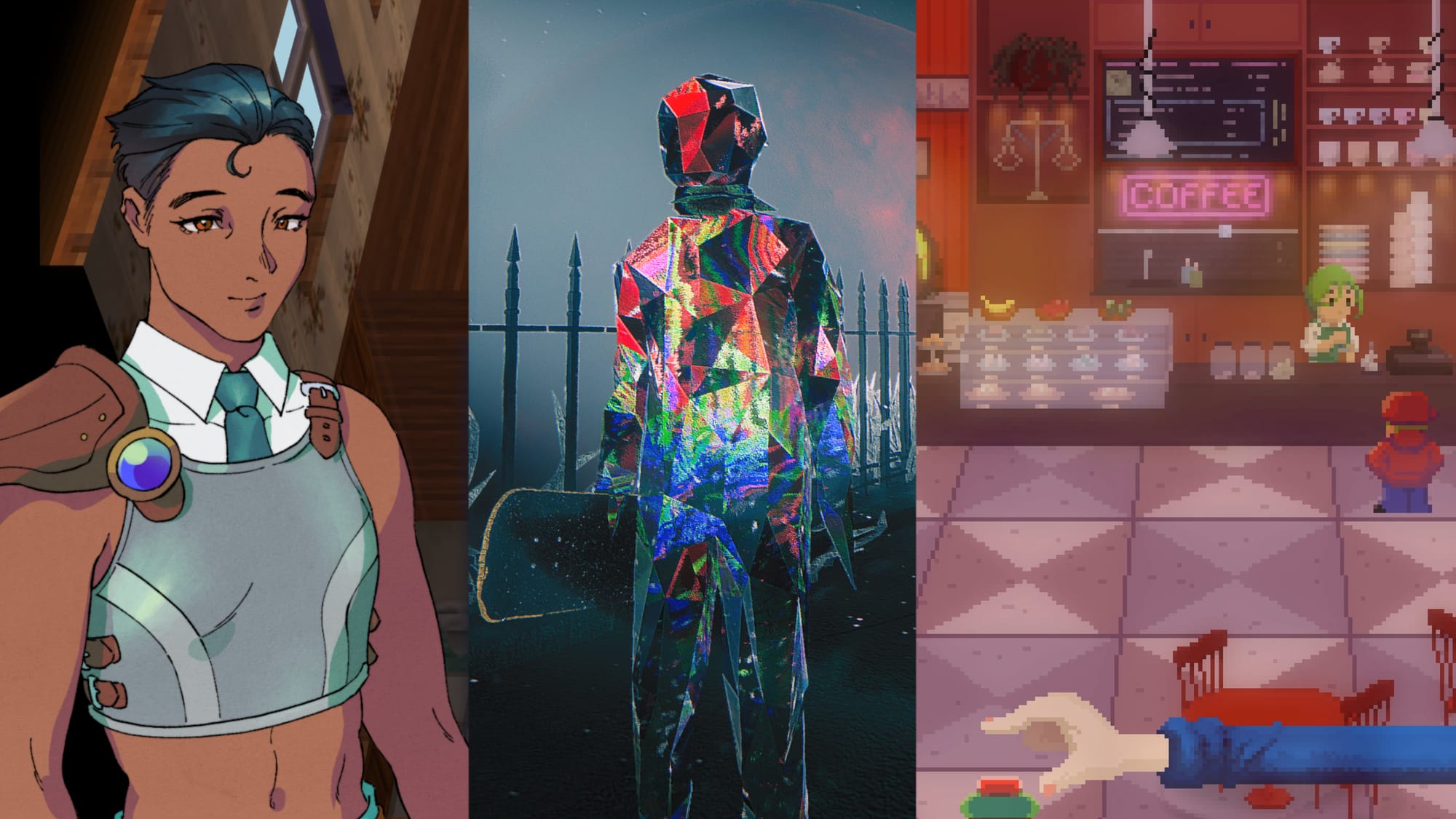
Toys? Sweaters? Those are gifts of Christmas Past. You should take a look around at the state of the world, at tariffs and shipping costs for material goods, and consider giving a gift that can be enjoyed by anyone on the planet, wherever they are and however they use the internet.
I'm of course talking about an Aftermath gift subscription, which can be purchased here and will grant the lucky recipient a whole year of access at our 'Member' tier, which lets them read every blog, score an invite to our community Discord, unlocks merch discounts and even includes a link to their own full-text RSS feed of the site.
As an added bonus, the money spent on the subscription will also go toward supporting Aftermath's full-time staff, contributors and freelancers, allowing us to continue the access-free, no-bullshit work you've come to expect from a worker-owned, reader-supported website.
Note 1: To have the subscription delivered on a specific day, make sure to select the desired 'Start Date' on the purchase form. You as the giver will be charged immediately upon purchase, but the recipient won't be notified (and their sub won't start) until the selected date. If the date is left as today's date, they'll be emailed (and their sub will begin) immediately.
Note 2: Gift subs can't be purchased for readers with existing paid subscriptions because...our system already recognises them as paid subscribers. They can be purchased by anyone though, whether they're an existing subscriber or not.
AFTERMATH GIFT SUBSCRIPTION
Buy someone special the sweetest gift of all: blogs
I don't want to be the Game Announcement Police here, ACAB, but over the last month there have been two big, new video games revealed that were notable not for what they showed off, but for what they didn't.
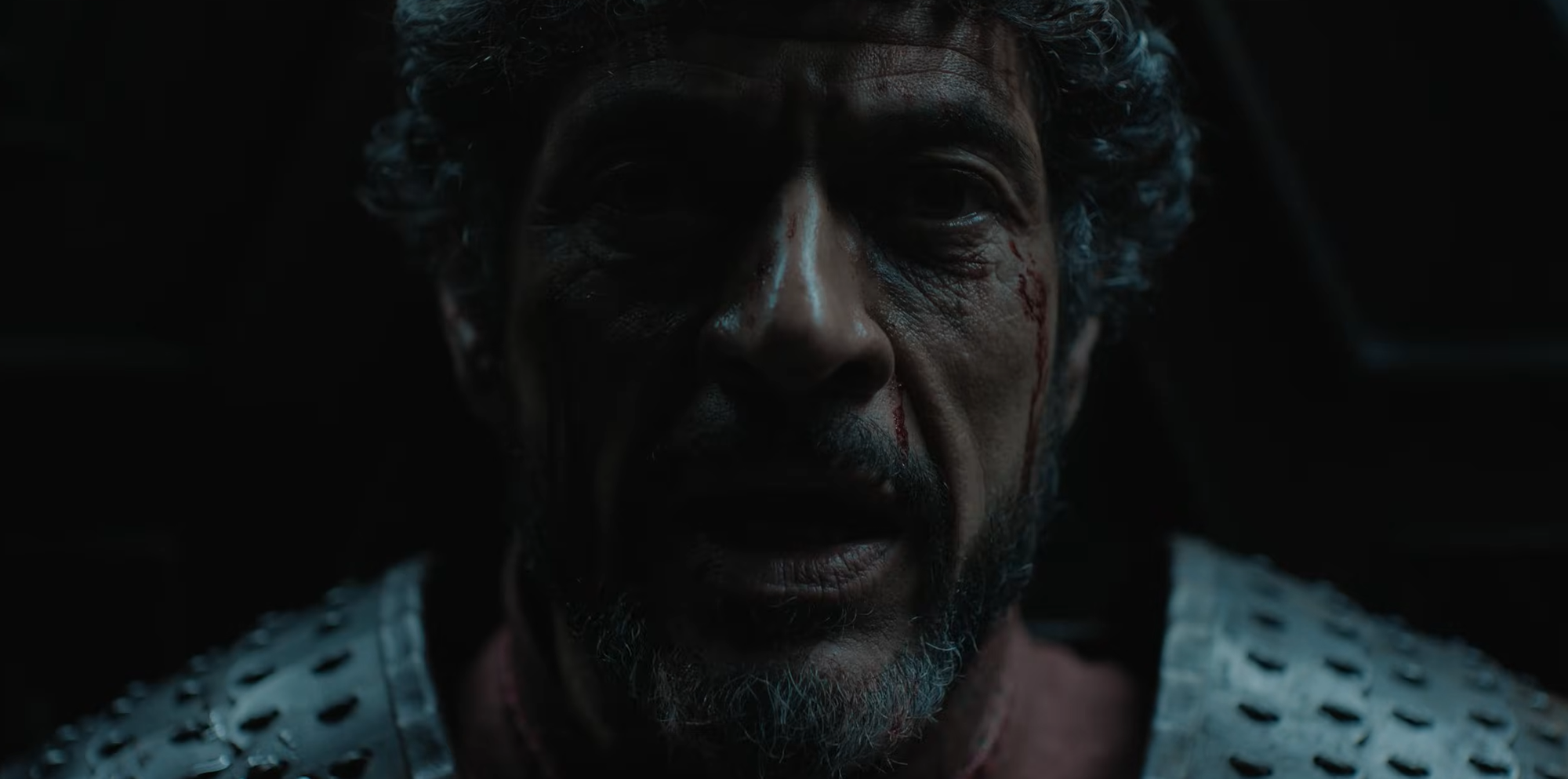
First up was Total War: Medieval III, which was announced via a live-action trailer (below) andblog post:
Amazing news! There hasn't been a proper historical Total War release since Three Kingdoms (I'm not counting Pharaoh's mea culpa), and Medieval is a long-time fan favourite, so this should have got people excited. Only problem is that there wasn't any gameplay shown. There weren't any screenshots. There wasn't even much art for the game, aside froma single piece shown at the top of a follow-up blog.
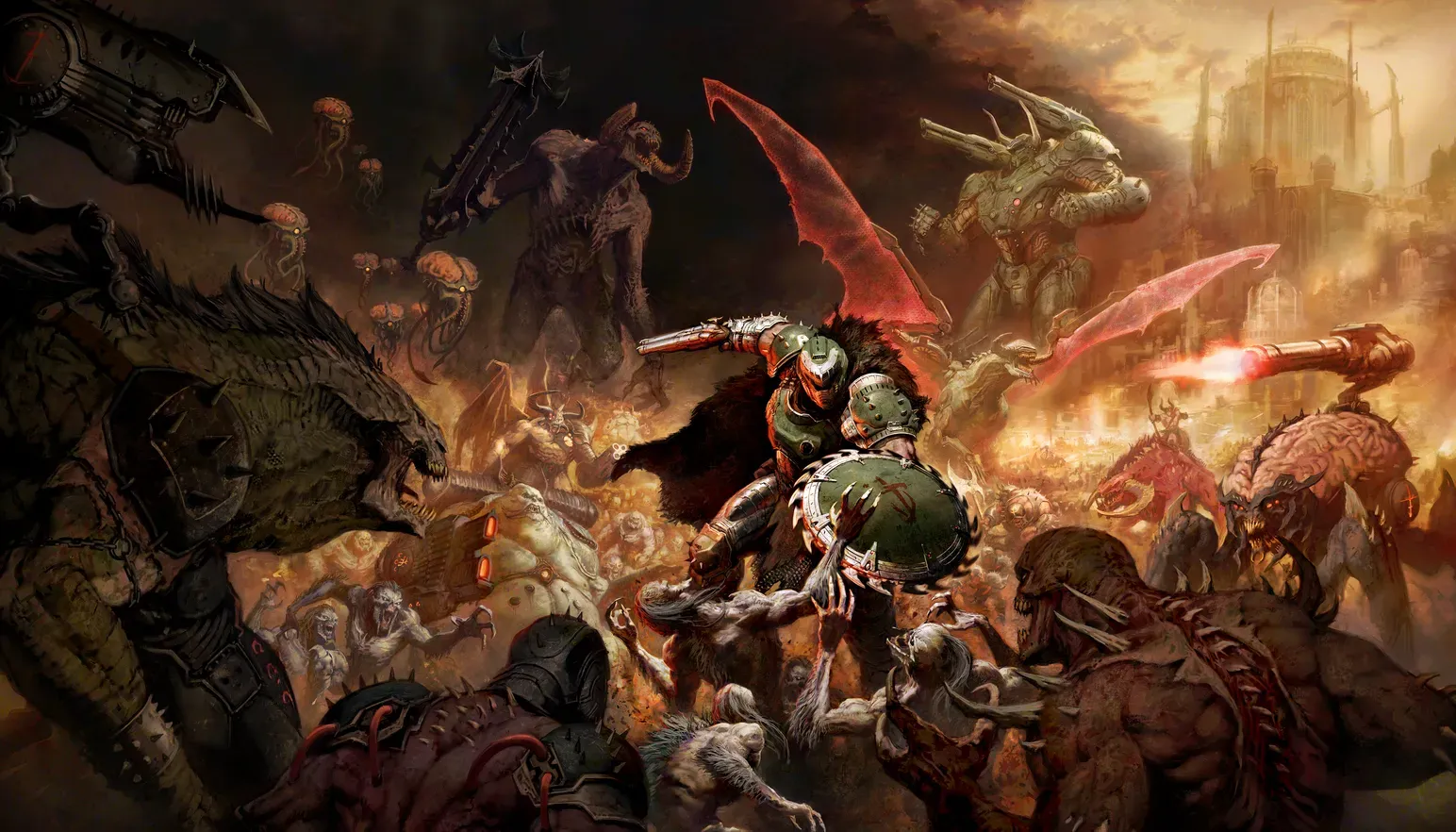
Only days later, Creative Assembly announced a second upcoming Total War game coming out much sooner, this time set in the Warhammer 40K universe, and its debut trailer was packed with gameplay footage, right down to giving us a look at the menus and interface.
I'm not drawing a very long bow here to speculate that the Medieval announcement was made a few days prior in an attempt to head off any uproar over the 40K announcement. For those unfamiliar with the franchise, there's a kind of uneasy divide among some in the community, with Total War's longest-serving fans (going back to 1999's Shogun) preferring the series' historical focus over the wilder, more fictional stuff that has featured in the Warhammer (and now 40K) entries. They look at how much money and effort has been poured into the Creative Assembly collab, then look at the relative neglect shown to the historical games (from endingThree Kingdoms support early to whatever the hell happened with Pharaoh), and get pretty mad.
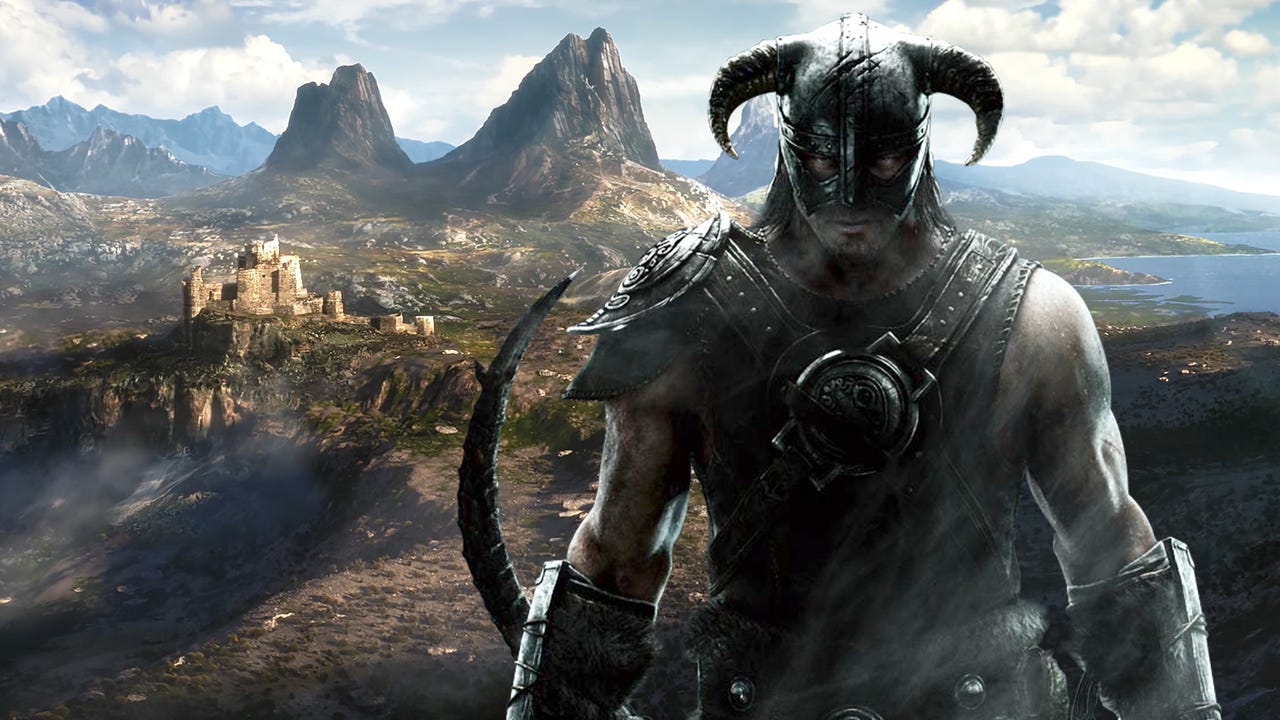
While getting Medieval III out in front like that probably made diplomatic sense to publishers Sega and developers Creative Assembly, I dunno, I think I'd rather a game be announced on its own merits and with something genuine to show off and talk about, rather than shoot a clip and write a blog just so you make some of your own fans less angry. Medieval III is clearly years away (they didn't even hint at a broad window for it to come out), and you went and announced a whole other game a few days later– you didn't have to Elder Scolls VI-ify your next big game!
The second game I wanted to talk about is even funnier. Earlier today Netflixannouncedthat Delphi, a company you've likely never heard of (they're relatively new, and their only public credit is as support on IO's upcoming 007 game) will be both developing and publishing a new FIFA game. You might remember thatback in 2022 EA Sports (developers of the long-running series) and FIFA (the world governing body for football) split, and ever since EA's series has been called EA Sports FC, or EAFC for short.
Netflix's announcement contains zero images or video of the game. And there's probably a good reason for that: the press release says stuff like "All you need is Netflix and your phone", and "We want to bring football back to its roots with something everyone can play with just the touch of a button", suggesting that whatever Delphi is cooking up, it'll be a lot closer to a casual mobile experience than the blockbuster simulation football fans have long come to expect from series like FIFA (now EAFC) and Pro Evo (now called eFootball).
That obfuscation has paid off handsomely, though, with a ton of mainstream coverage of the announcement hitting today with headlines like:
There's a small mention of what I've just said above at the bottom of that BBC article, but as a mainstream article intended for a mainstream audience, I guarantee Delphi and FIFA will be thrilled at the number of water cooler and group chat conversations this week that will revolve around the talking point "Boys, did you hear FIFA is coming back?"
Last week, Warframe’s hotly anticipated Old Peace update launched, kicking off a saga that digs into the very foundations of the nearly 13-year-old game’s lore. Of course, like clockwork, servers immediately took a tumble, resulting in crashes, outages, and chat issues. But why has this pattern become so predictable with online games? Especially when developers are well aware that a storm of their own making is on the horizon?
During a Game Awards-adjacent event celebrating The Old Peace’s launch last week, I asked creative director Rebb Ford.
"You've gotta spin up capacity,” she told Aftermath, referring to the practice of paying money to a distribution partner for additional servers ahead of or during moments when many players will be trying to access content. “You're allowing so many connections. We're an always-online game, right, so every time a player does something, there's a server call. There's something that needs to be verified server and client side. … Login, mission complete, anything that needs to talk to us to say 'You did this, you did that’ – it happens to us at a volume level that's very hard to account for."
In The Old Peace’s case, Digital Extremes was ready for a stampede the moment it opened the gates, but not quite ready enough.
"We actually didn't fall over as much as I thought we would,” said Ford. “That's when we realized 'Oh, we didn't think this was gonna be bigger than TennoCon [Warframe’s annual convention that often drives record player numbers].' We spun up IRC servers, we spun up things just to deal with volume. But sometimes you just cannot be prepared enough when you didn't predict it to be the third-best day in the history of the game. That was an error on our part, but it's not so much a tech error; it was an anticipation error. We fixed it very quickly."
The ability to quickly rectify server issues is also the result of preparation – in some cases years of preparation.
"One of our most important things to do is make sure people can get the content as fast as possible,” said Ford. “With Warframe, when we have the build or the update, we release it to our distributing partners, and we do something called a pre-heat of our CDN, or content delivery network – which is basically us saying 'People shouldn't all be fetching the game data from one node.' Because that will take forever. It'll get congested. So we distribute it, and this is through years of network partner shopping, working with really good network partners. We have content servers in 16 or 17 central population hubs."
The pre-heat, Ford explained, ensures that the whole network doesn’t hinge on a single point of potential failure.
“So sometimes you'll be going in the Philippines instead of being routed to our deploying headquarters, which is Ontario,” she said. “We pre-heated our server structure across the globe so that people can fetch [new content] quicker, and that takes a lot of load off.”
But that’s only one stair in what Ford characterized as a winding staircase of individual, overlapping needs.
"So that's the first point of failure: Can you download the game at all?” she said. “Second point of failure is: Can you login at all? When that happens, that all comes to us through login capacity. That one, you just have to spin up more capacity. Then you have the question of 'Can people play missions?' So you can kind of see the staircase: Can you download the game? Can you login to the game? Can you play the game? And each one of those is a slightly different sector of stability."
In Warframe’s case, elements can function independently, but if they’re not all working in conjunction, players quickly begin to see the seams.
“A lot of people can be logged into the game, and that's cool, but if you can't play, [then there's a problem],” said Ford. “It's like Maslow's Hierarchy of Needs. Can you chat? You don't need chat to play the game, but chat servers run independently. Those were hit the hardest [on Old Peace launch day], and we fixed it fairly fast by spinning up more capacity."
Games are complicated, as is the process of distributing them to millions of different computers with as many hardware configurations as there are stars in the sky. You will not be surprised to learn, then, that many other things can also go wrong.
“We have issues where we release new code in this build, and then maybe one piece of code fires every second on a heartbeat,” Ford said. “And sometimes we find these heartbeats, and we're like 'What is pinging the servers every second on the second,' and we're like 'It's the new title system we put in,' for example. ‘It's checking against server-client to issue you a title, but it's doing it in a way where we were unsure because it's checking all this indexed stuff.’"
Warframe has been around for over a decade and regularly pulls in tens – or in Old Peace launch day’s case, hundreds – of thousands of concurrent players. Nonetheless, said Ford, Digital Extremes still frets about The Ramifications as though it were a much smaller company.
"We still feel very young and scrappy, and we're like 'Can we even afford $600 more per month in capacity?'” she said. “That's the kind of question we ask ourselves on launch day. And then we're like 'Just do it! Just do it!'"
Warframe’s servers weren’t quite able to withstand the sheer weight of years’ worth of anticipation on launch day, but Ford was relieved that they didn’t go down for “hours and hours,” which would’ve necessitated a suitably less jubilant speech at the launch event in LA.
"It's exciting. It's thrilling. Everyone did an amazing job,” she said. “We asked our team to do the impossible with this update, so even though those little hiccups happened, we had two speeches prepared – funeral or the celebration – and we undoubtedly got to do the celebration."
Pendleton Ward, the creator of a little show you might’ve heard of called Adventure Time, worked on a new Adult Swim animated special called The Elephant. He didn’t make it alone—Ward teamed up with longtime friends and Cartoon Network alumni Rebecca Sugar (Steven Universe), Patrick McHale (Over the Garden Wall), and Ian Jones-Quartey (OK K.O.! Let’s Be Heroes). The show, which saw the Avengers’ line-up of cartoon legends craft something without knowing what each other would contribute, gave Ward the jitters over whether their collective, experimental tale would coalesce into something worthwhile. What frightens Ward the most, though, is his thoughts about AI and how it may leave the animation industry as we know it as a hollow, not-so-exquisite corpse.
Over the course of his career, Ward has built a strong body of work as both a creator who shaped a formative part of an entire generation’s childhood and a champion of animation itself. Through Adventure Time alone, creatives like Sugar got a rocket strapped to their back, launching them into their own career, all while carrying the flame of crafting bold shows of their own that spoke to adults and kids. The gravitational pull of Adventure Time’s elevated arthouse approach to animation—often serving as a cultural bridge, exposing Western audiences to international talent like former Science Saru creative Masaaki Yuasa—embraced creative freedom without hesitation. Ward can easily be credited as one of the bricklayers of this era of highly creative animation, which The Elephant harkens back to. It’s an era that feels on the precipice of dwindling, piece by piece, under the guise of AI as the supposed end-all, be-all of artistic innovation.
After reviewing The Elephant, I walked away with the stark feeling that the special emphatically reached out from beyond my screen, cupped my face, and said, “fuck AI.” When I asked him if that was at all the intent, Ward reminded me that the collaboration was a bit of a misnomer, since he and his peeps couldn’t communicate about what they were contributing to the special’s three acts, not knowing how the whole thing would come together, but trusting that it would be fun.
“What you’re describing is the magic of this piece of art. That there is a meaning [that] emerged from our blind connection of pieces. But in the beginning, all I knew was that I could only get close to feelings of things and not anything too specific,” Ward told me. “‘Cause if you get too specific, you’re creating a wall that may not be passable.”
When I raised the elephant in the room—AI’s looming role in the industry—Ward characterized the magic of The Elephant’s existence as a very cool “last squirt of human creativity.”
“It’s gonna be weird. I think people are gonna like AI, though,” Ward told me. “It’s gonna be heinous in many, many ways, and it’s gonna destroy the industry—but I think people are gonna like it, ultimately.”
Adult Swim
Whenever Ward thought about the state of the art in the rise of AI, iron bars came to mind, he said. Ward clarified that it was less about prison and more about the lost appreciation of artistry in our day-to-day lives.
“People used to craft everything. Now, when we look at drywall or something, it means nothing to us. Walls used to be crafted. I think about shaping iron bars. Now, when you walk by those things, they mean nothing because they’ve been industrially manufactured along the factory line,” Ward said. “I feel like that’s going to happen to art at some point, where art’s gonna be this thing that you barely have any appreciation for because it’s all just been generated by machines that have no feelings.”
While there will still be artists, Ward fears it’ll become a niche hobby, with artists reduced to people who whittle wood, making small things that take hours to make.
“It’ll have value in that way, the way that all original works still have value. But it’ll just become a smaller and smaller group of people doing it for a living ‘cause you won’t be able to make money,” he said.
With major animation companies like Disney playing both sides—pearl clutching over protections against AI while partnering with OpenAI for profit—Ward and his motley crew of animators are living through a time when the integrity of their craft is under constant threat. Sure, there’ll always be an animation industry, like there’ll always be journalism. But if you want to break through and be a part of it, you’re gonna have to be okay with being poor and deal with AI debasing your craft and calling it progress.
Ward sees an inkling of a silver lining in AI—at the very least—creating new jobs for humans willing to work there. But he can’t help noticing how broken a future is where artists push their creativity beyond its limits while still trying to sell commercial art, created in a way that is generic enough for people to relate to, only to have that blow up in their face.
“If we're just hired to push the boundaries of art so that AI can eat up all of our ideas and spit them out in different ways, those jobs will become like incredibly creative jobs, because we'll be needing to push the limits of all styles to feed the AI beast and give it more imagination,” he said.
Notice how the left lacks all the soul and whimsical charm that makes the right one so pleasing to look at
Despite The Elephant embodying the spirit of a work that’s preserving the soul of animation where human creativity served as the bedrock of its bold and frightening existence, Ward couldn’t help but stifle a laugh when I bluntly asked him if he thought we were cooked. His response, while dour, was brutally honest.
“Kudos to Adult Swim for making cool stuff and having cool choices like making The Elephant. But yeah, we’re cooked,” Ward said. “AI will be implemented at some point because it saves studios money. It just has to happen at some point, and it just keeps getting better. Time’s a changing.”
You don’t need me to tell you that the world is a hellscape lately, but a fun thing about living in it is that it’s full of people with specific interests or niche areas of expertise, and they know all kinds of things you don’t know that you can go learn from them. Recently-released video game Morse is about Morse code, a very niche interest, and is even getting some people into telegraphy, an even more niche interest.
I feel like I’ve been hearing about Morse for years (10 years, apparently!), and it finally released in November. It’s changed quite a bit from the demo I played last year, which featured a narrative; now, you fend off growing waves of enemy ships on a grid you navigate with Morse code.
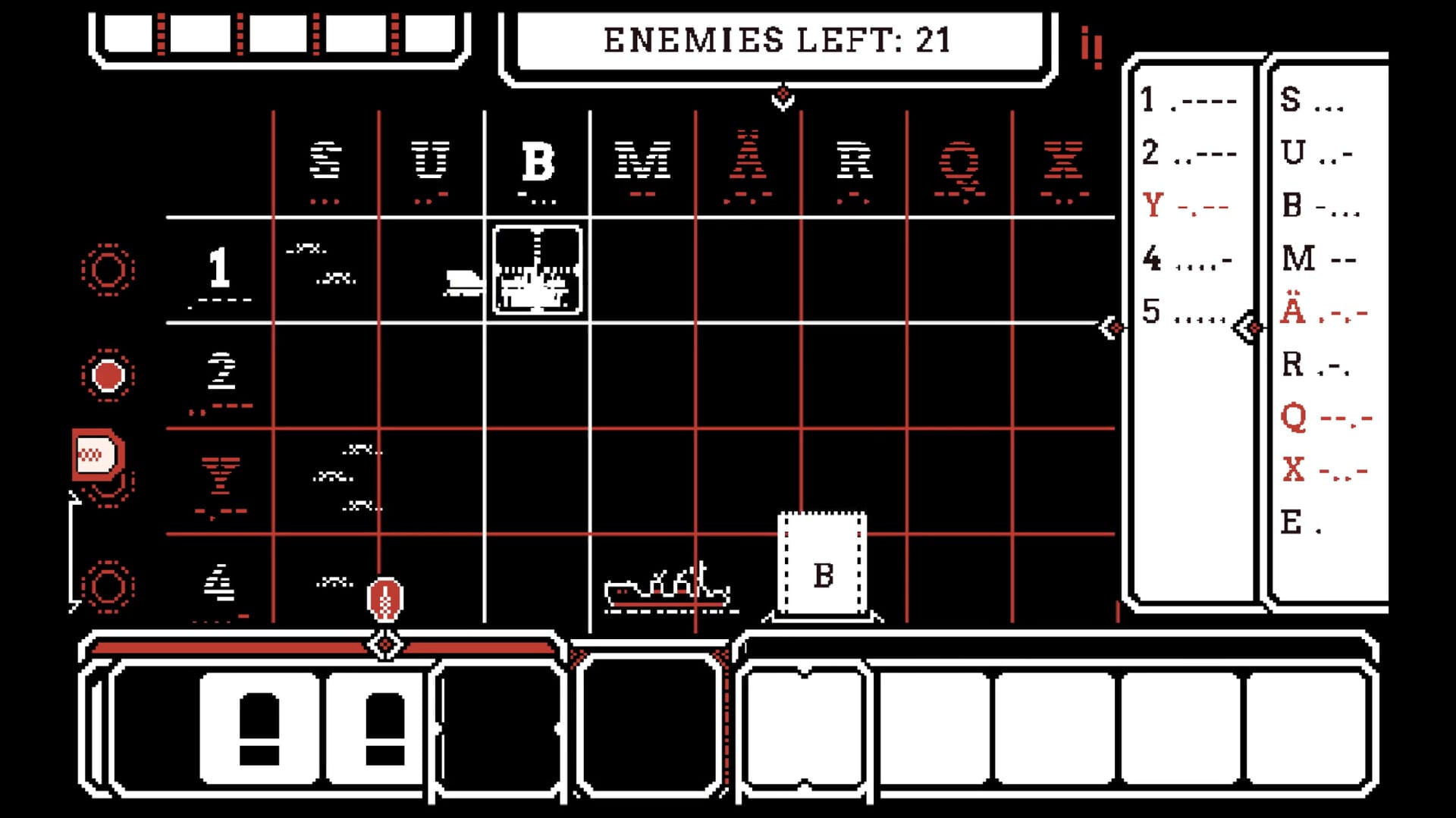
You tap out letters to move your cursor between grids and squares, all while enemy ships steadily approach from the right side of the screen. You can’t see them at first, so you need to set up mines to reveal them, or fire exploratory rounds to get a sense of what’s happening. As you move through the game, you unlock and upgrade weaponry, but things also get tougher: more ships to beat back, and more rows and columns to frantically dot-and-dash your way around.
I’ve only spent about an hour with the game, but I’ve really enjoyed its very specific mix of stressful and calm. In one way, it’s frantic; there’s way more ground to cover and problems to deal with than I feel like I can, and I’m constantly scanning the field and clicking away with my mouse to dart around. On the other hand, there’s something particularly slow about the whole thing. Tapping too fast will cause you to enter the wrong letter or nonsense instead of letters, so you need to take your time to keep from getting jumbled up. There’s a bit of a delay before you move, and shells take some time to load in. So peppered among a chaotic battle are all these micro-moments of downtime, and the whole game requires a kind of intentionality and level-headedness to succeed at that, when I pull it off, really makes me feel like I’m mastering a skill.
The ideal way to play this game, obviously, would be with an actual telegraph, which has been an option at festivals but less so at home. The Steam forums have a guide on how to get, build, or use one, and players have shown off their ownversions online. It’s a game that invites weird controllers and making your own weird controllers. While I am not a controller sicko like Chris Person, I can respect people who are, and the pared-down input required for Morse seems like an approachable way to get into tinkering.
Morse code and its preservation isn’t something I’ve thought a lot about, but there’s a whole world of enthusiasts out there keeping it alive. In an email, developer Alex Johansson said he hopes to use Morse to introduce more people to a hobby with an aging population, which is an issue I have literally never considered before–what happens if there’s no one left alive who knows Morse code? I love how such a simple little game has given me a peek into a whole world I knew nothing about, with its own customs and lingo and values. Instead of doomscrolling the news, you could be learning Morse code! Maybe the world isn’t so bad.
By executive order last month, Donald Trump launched his so-called “Genesis Mission.”
Described as a “historic national effort” to “invest in AI-enabled science to accelerate scientific advancement,” Trump claimed his mission would address key challenges to American energy dominance, innovation, and national security.
This mission, Trump boasted, would be a game-changer to science akin to putting a man on the moon or firing the first nuclear weapons. By building “an integrated AI platform” trained on “the world’s largest collection” of federal scientific data sets, he promised, the government could set off cascades of scientific breakthroughs.
Earlier today Bloomberg's Jason Schreier published aninterviewwith Swen Vincke, the CEO of Larian, the company behind the internet's favourite video game and demonic relationship simulator Baldur's Gate 3. It could not have gone worse for the guy.
Among all the expected pre-release interview talk about how their next game, Divinity, will be making all kinds of improvements over their last game, there was this:
Under Vincke, Larian has been pushing hard on generative AI, although the CEO says the technology hasn’t led to big gains in efficiency. He says there won’t be any AI-generated content in Divinity — “everything is human actors; we’re writing everything ourselves” — but the creators often use AI tools to explore ideas, flesh out PowerPoint presentations, develop concept art and write placeholder text.
The use of generative AI has led to some pushback at Larian, “but I think at this point everyone at the company is more or less OK with the way we’re using it,” Vincke said.
Holy fuck guys we’re not "pushing hard" for or replacing concept artists with AI.
We have a team of 72 artists of which 23 are concept artists and we are hiring more. The art they create is original and I’m very proud of what they do.
I was asked explicitly about concept art and our use of Gen AI. I answered that we use it to explore things. I didn’t say we use it to develop concept art. The artists do that. And they are indeed world class artists.
We use AI tools to explore references, just like we use google and art books. At the very early ideation stages we use it as a rough outline for composition which we replace with original concept art. There is no comparison.
We've hired creatives for their talent, not for their ability to do what a machine suggests, but they can experiment with these tools to make their lives easier.
Which only made things worse! Because instead of explaining himself, all his follow-up showed is that Vincke does not appear to understand what it is that his art teams actually do, or indeed how their art is made.
consider my feedback: i loved working at @larianstudios.com until AI. reconsider and change your direction, like, yesterday. show your employees some respect. they are world-class & do not need AI assistance to come up with amazing ideas.
That's OK, Swen, let me explain it for you! Firstly, any use of AI fucking sucks. It's a creative, economic and societal disaster, so really, there's no excusing its use in any circumstances. That's why people got so upset about the initial quote. But to get more specific, let's take a look at your justification.
Saying you only use AI for "reference" is wild. Artists use image searches and books as inspiration because they are drawing on art (but also everything else from colour palettes to photos to the weather). There's experience there, things they can relate to, be inspired by. There is no inspiration in slop! Everything AI is presenting to you is simply stolen and amalgamated. It's like asking your phone's autocorrect for relationship advice.
If you are using AI to generate ideas to explore, that is using AI in your game. This is duplicitous spin to say otherwise. The entire history of creative industry happened just fine without using AI, there is no need to shoot your game in the foot by using it now.
There's an unsurprising tendency across leaders in the tech world (games included) to see art as merely part of something's production line, a box that needs to be ticked before copies can be sold. It's why AI is often justified as something that saves time, or saves money. But with art, that process is the point. The themes and ideas artists draw on, the way they iterate through those ideas with sketches, the work itself is what creates art. There are no shortcuts.
In a lot of ways, Larian was a poster child (alongside folks like Remedy) for how retaining a team and continuing to refine a toolset makes seemingly impossible things achievable.
Why spend 2 years talking about how critical this was to BG3's existence--and then say major parts of it don't matter?
This memorial account was set up with the assistance of Open Doors and Irishcaelan, the maintainer of Randall’s personal website, Randall’s Rambles. Randall also wrote under the pseudonym Brian Hennessey. Randall Morgan was taken from us in 2013, and this site is a permanent place where the fanworks he so loved to create will go on.
Open Doors will be working with Irishcaelan to import Randall Morgan’s works into a separate memorial account on the Archive of Our Own. As part of preserving his works in their entirety, all graphics currently in his works will be hosted on the OTW’s servers, and embedded in their own AO3 work pages.
We will begin importing works by Randall Morgan to the AO3 after December. You will find them on the RandallMorgan_memorial account.
We’re honored to be able to help preserve the works of Randall Morgan, and while we mourn the loss of Randall, we also realize that we are fortunate that he had a friend who was given permission to collect and preserve his works on the AO3 so that they will not be lost. Thinking about the death of a fandom friend may be difficult, but it can also be an opportunity to consider what will happen to your fanworks and accounts and those of your friends after your deaths. The Archive of Our Own has an option to name a Fannish Next of Kin, someone who would be able to gain access to your accounts in the case of your death or incapacitation. By naming someone who can act on your behalf, you can decide ahead of time how you want your AO3 accounts handled going into the future.
– The Open Doors team and Irishcaelan
Commenting on this post will be disabled in 14 days. If you have any questions, concerns, or comments regarding this import after that date, please contact Open Doors.
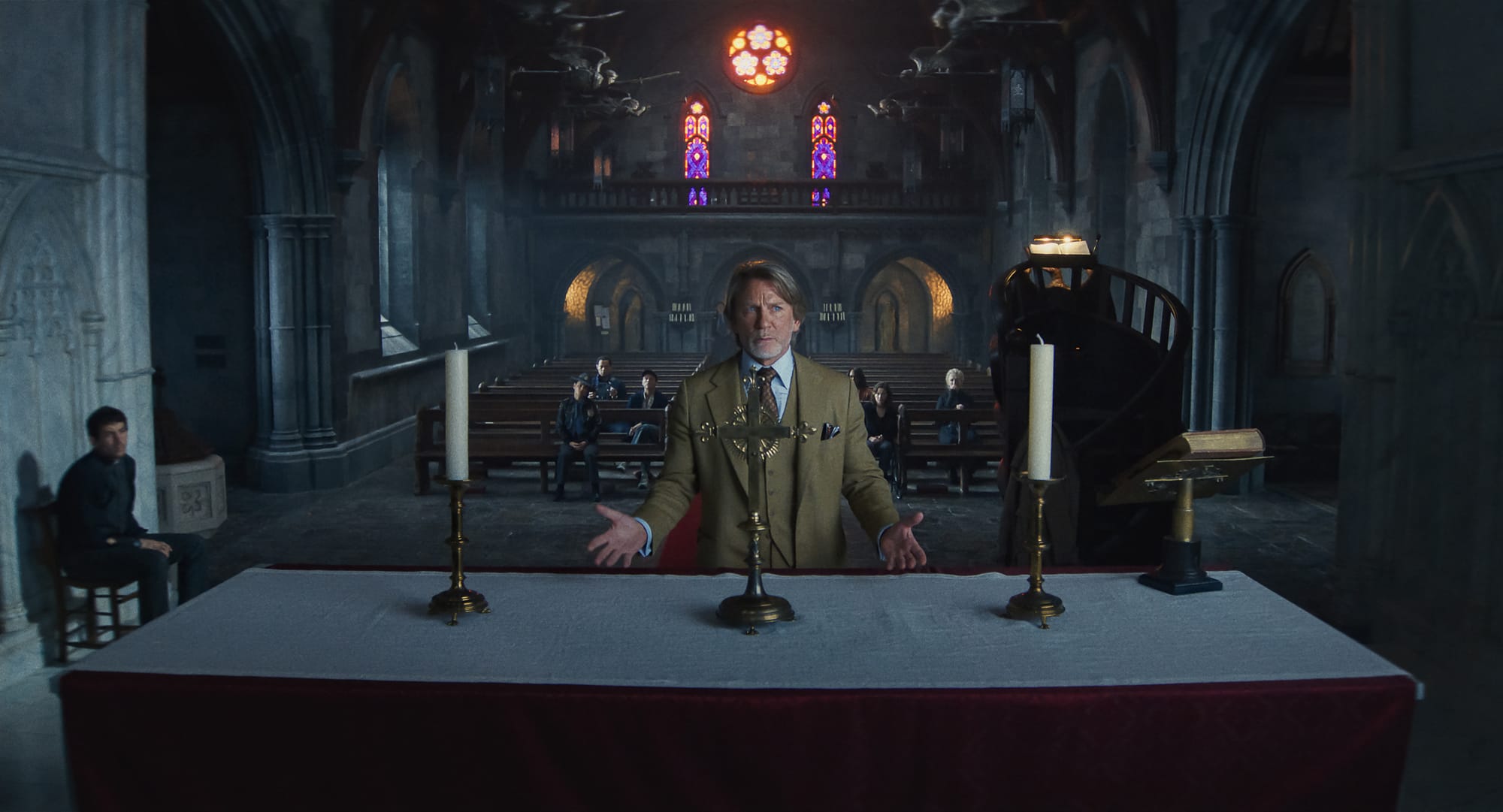
In what's become a tradition around the holidays, Wake Up Dead Man, the third whodunnit murder mystery film in Rian Johnson's Knives Out world, is on Netflix after a short theatrical run. This time around, Daniel Craig's utterly charming Foghorn Leghorn private detective Benoit Blanc is tasked with solving an impossible crime where a priest was killed inside his church. The suspects: his congregation. Dun dun dun! However, what brings us here isn't the whodunnit of it all, but the how done it. More specifically, how the film handles religion. And what better way to do that than have Aftermath's resident expert, Riley, chat with Midnight Mass defender Isaiah about how the film handles theology.
Riley: Oh my gosh, we've never argued about Midnight Mass. For another blog!
Isaiah: We'll throw down in the free marketplace of ideas on that one! So, I threw down the gauntlet weeks ago after we had a bit of a side chat about Midnight Mass and how I think it holds up years later with my own curiosity for how you'd feel about Wake Up Dead Man after I came out of theaters to watch it. I guess to start off, with that as its premise, did you have any reservations about how the film would handle religion?
Riley: I did! I have a lot of very smart friends who were praising it ahead of it coming to Netflix, so I had high hopes. I think big picture I wasn't as "wow"ed by it as some of them, but I think a lot of that is that I like the Knives Out movies fine, but they never really blow me away. When Blanc first shows up at the church, I was worried the movie's big conflict was going to be "believer" versus "non-believer," which I personally find to be a bit of a tired topic in secular media about religion, even though I totally get that it's one that's surely on the minds of a lot of creators.
I think Wake Up Dead Man does use religion to provide an interesting twist on the standard whodunnit formula, where about halfway through it injects a bit of theology into things: is solving the murder "justice" from a theological perspective? How should we treat people who do harm? These are the sorts of questions that don't really come up when religion is just used as set dressing, so I really appreciated that.
Netflix
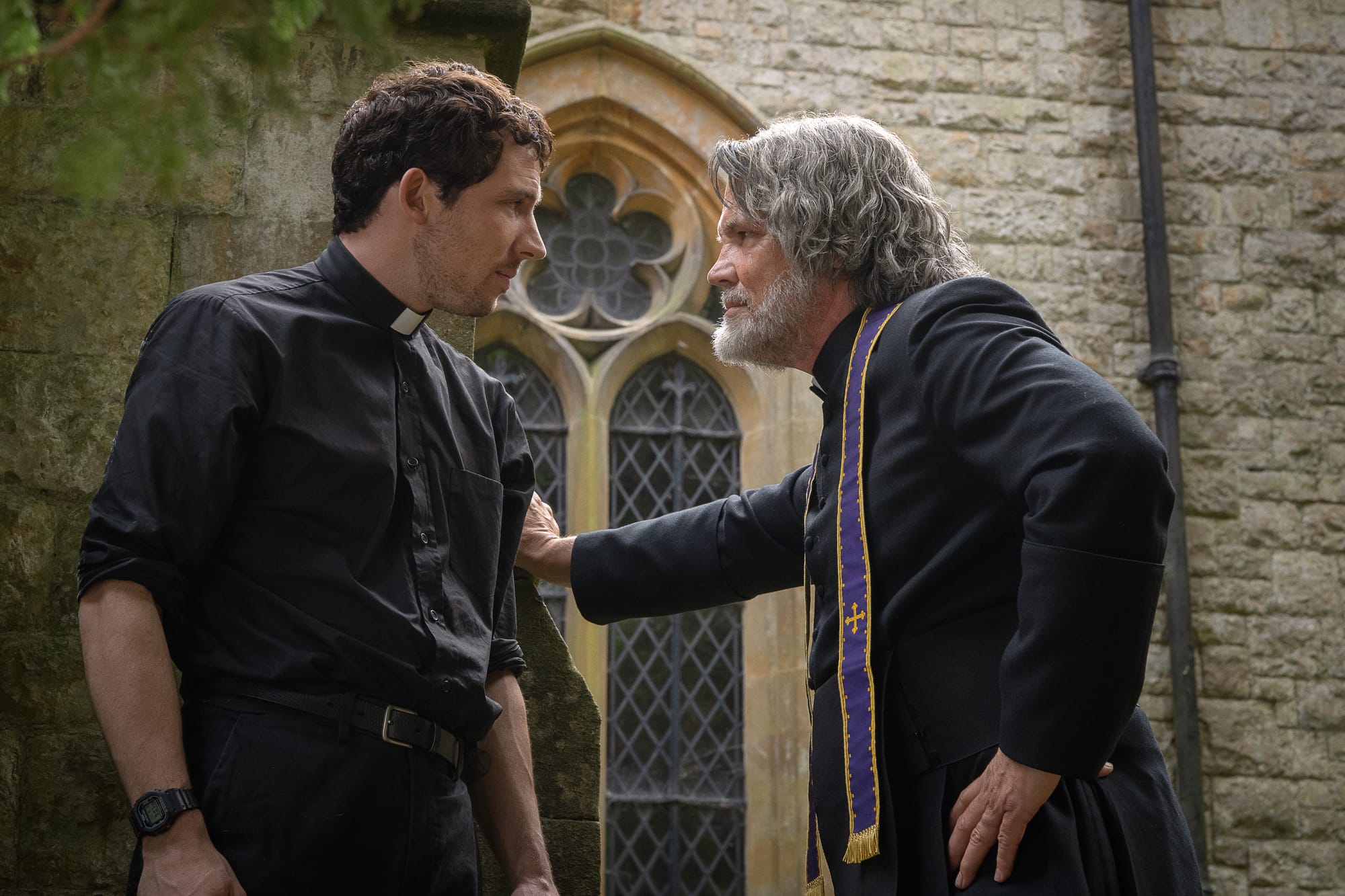
Isaiah: I feel you on that. When I first watched it, I was kind of bracing myself for Blanc, as a gay man with an unmistakable southern accent, to have a huge axe to grind about religion when he first hit the scene like Kermit the Frog in The Muppets. While sure, he definitely made his qualms about religion known, he didn't harp on them or let them guide the film's direction toward a tropey religion vs atheism diatribe. And because of that, I think the film stands out from the others as a more personable one where we're wrestling with themes of justice and grace, and where one might fall in a murder mystery like this one. In rewatching the movie yesterday, one scene that spoke out to me was when Josh Brolin's Monsignor Jefferson Wicks comes to blows (literally) with Josh O'Connor's Father Jud Duplenticy.
For context, Wicks is kind of an asshole pastor who weaponized religion as a means to bully new parishioners by calling out their insecurities in his sermons. He winds up dead in the movie, kicking everything off. Jud is a new pastor at his church charged with helping prevent its dwindling numbers. Anywho, they have a whole falling out when Jud calls out Wicks for his hateful hazing of everyone in his congregation and his galvanizing of himself as a warrior of Christ. Wicks, after punching Jud in the gut, says, "I'm the world. You're the church." When Jud instinctively recoils in a defensive boxer's stance (because he used to be one), Wicks applauds him. His overall point is that anger lets folks (i.e., the church) take back the ground they lost to protect themselves and that the world ultimately wants to destroy "us."
Netflix
"Your version of love and forgiveness is a sop. It's going along to get along with modernity, not wanting to offend this garbage world. Meanwhile, they destroy us." Granted, he goes on to define those seeking to destroy them as "feminist Marxist whores," but his sentiment is that the kind of rage-baiting algorithmic outrage that we see in social media, reflected in his sermons, is the only way for the church to buck back. It's something the film spends the rest of its runtime wrestling with. But I wanted to ask, what did you think of that scene?
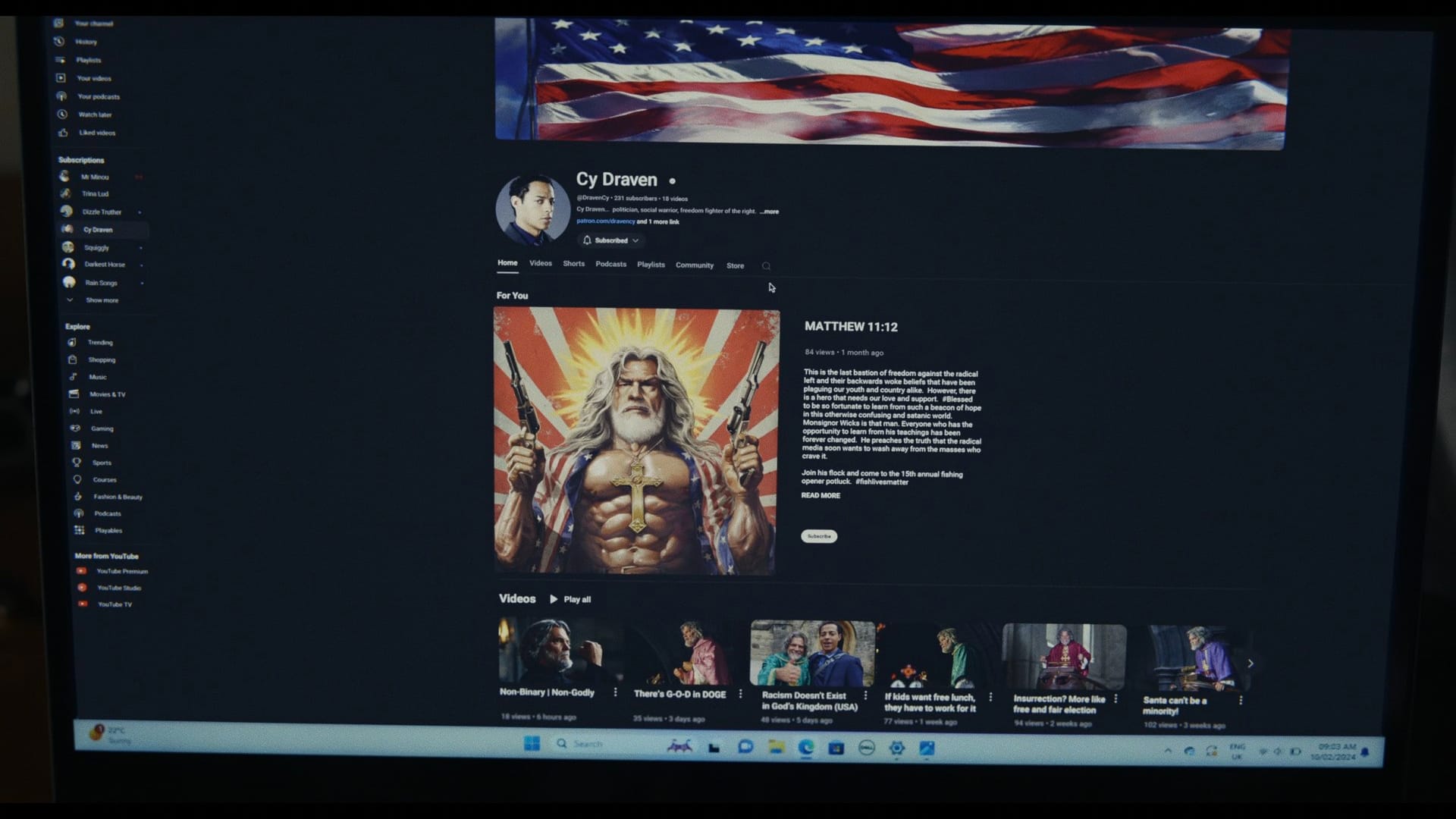
Riley: I think the movie touches on, if never fully dives into, a real tension we're seeing in a lot of denominations these days, or maybe accurately a tension we're seeing politics inject into denominations. As faith gets co-opted into our current American version of the Right, we're seeing a growing presence of a kind of aggressive, hateful, "crisis of masculinity" version of Catholicism through, say, JD Vance and co. And I'd argue we saw a similar thing in Protestantism with the Young, Restless, Reformed movement that gave us (and somehow keeps giving us) Mark Driscoll and his ilk. Wicks and his congregation touch on that: he feeds on insecurity and exclusion, and on this idea of Christian persecution that we're seeing Trump play into.
Netflix
It's a powerful message for people, especially men, who feel done wrong by, and we see it resonate with Wicks' congregation even as it drives other people away. And I think it's interesting how Father Jud isn't simply the alternate view--he also struggles with violence and domination and a desire for conflict, and he works through that in the movie in an arc I don't think we see in a lot of movies about faith. When these ideas first came up I thought maybe the movie would get into, say, Christian nationalism or something, and I appreciate that it stays focused on its own little corner of the world, even as I think it had a chance to go bigger.
Isaiah: We've lightly touched on it earlier, but I wanted to ask when it comes to movies tackling theology, what are your icks? Or at least what are pitfalls you've seen countless times that turn you off to them?
Riley: I think way too often religion is just set dressing or a stand-in for "the bad guy," especially in video games. And here's where I have to throw my standard disclaimer: despite being a queer trans man, I have managed to live a life where religion has never had the power to hurt me; I've always been able to leave a faith space that felt unwelcoming or unsafe, and I always want to stay aware that that's a privilege a lot of people don't have, and I would never begrudge anyone having a hostile view of faith as a result.
But that kind of "outside looking in" view, I think, leaves a lot of really interesting stories about faith on the table, and simplifies into an institution something that is really complex and personal for people. I think stories about faith also often boil down to stories about blind adherence--this is one of the reasons I really didn't like Midnight Mass--and that too really misses space for complexity to me. By making Wake Up Dead Man's antagonist and protagonist both people of faith, it lets the movie wrangle with loftier, more interesting topics than just "is God real?" or "are religious people bad?" that I think we see in a lot of media.
Netflix
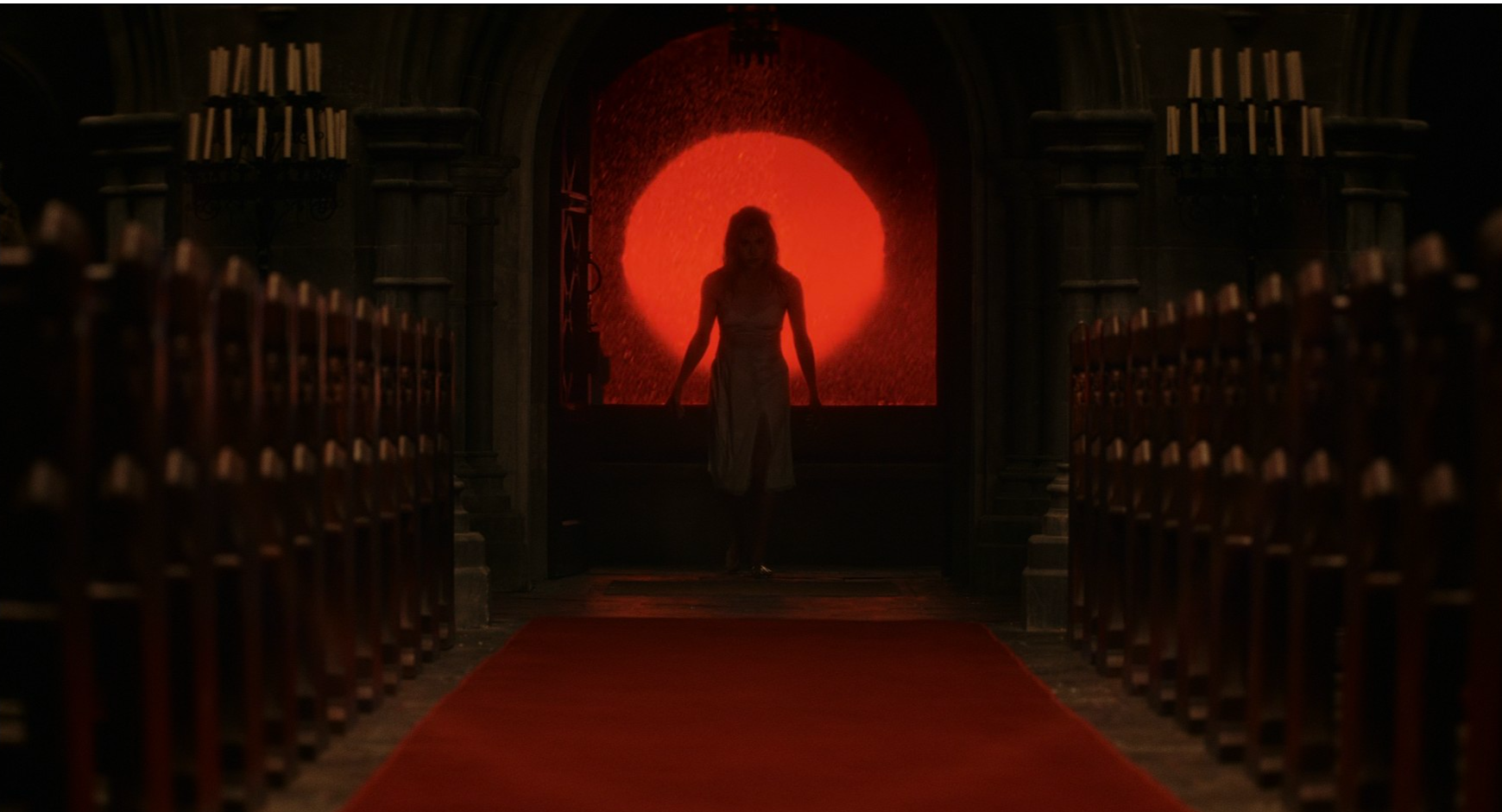
Isaiah: I think too, the film's showcasing of perspectives with memory—something that's become a signature of Johnson—where we see similar events play out from different points of view, depending on who tells it, sings better here than the other Knives Out movies. Thinking back on Grace's desecration of the church and how at first it had her looking like a primordial evil made flesh. A belief Wicks' church perpetuates with remembering her solely as the "harlot whore." I felt that the film bringing back that visual motif of events from different emotional memories played against Benoit's more concrete video evidence of events and recounting did a good enough job of hewing to what faith means to different people and how at times that can warp depending on how one can personally justify it to themselves.
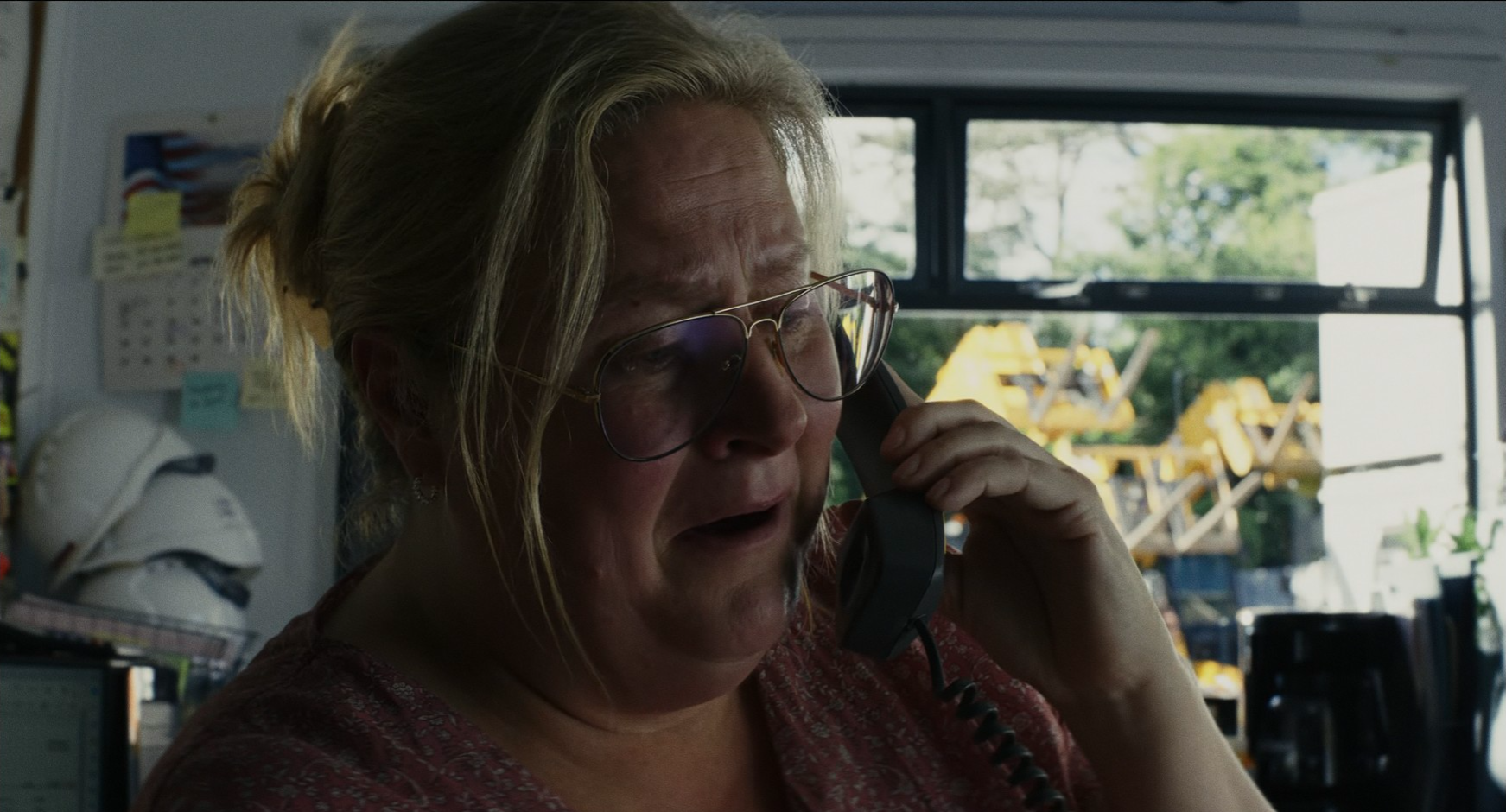
Another scene I wanted to bring up, which is my favorite for how it derails the whole game of the murder mystery, is Jud's call with Louise. It's pretty much when the momentum of the film at its halfway point gets really close to stringing along a path to finding a culprit, but, to Benoit's chagrin, it's railroaded by Louise asking Jud to pray for her. More specifically, to pray for her and her mother, who is in hospice, and they had a falling out that she doesn't want to be the last thing she remembers. It's a pretty arresting scene because it goes from being played up with laughs with how you can call a business for pertinent information, and the person on the other end wants to shoot the breeze. But I felt that whiplash, and Jud's attentiveness to hear her story was something special.
Netflix
It felt especially targeted to me with the passing of my aunt recently, who was more about religion than I was, but I couldn't find the heart to tell her that. Still, it's a scene that felt so sincere in the rest of the film's kind of quick-wittedness, and it really spoke to how it wasn't taking religion simply as set dressing. That the whole having grace to meet people where they are with Louise and with how the film's climax doesn't do the routine reveal of the culprit was a neat way to take the murder mystery premise and flip it on its head by letting religion take the reins on how to approach this otherwise cliched story.
Riley: Yeah, I've seen a lot of talk about that scene. It's really startling; it stops the momentum of the murder mystery cold, and while it could have been played for laughs, instead it's really sincere and, to me, lovely. I have a friend who's a Unitarian minister, and when he first got ordained I remember us having a conversation about what he should do when people stop him in his clerical collar and ask for a blessing or something, especially when they think he's Catholic. And we both decided that in most cases it was just a lovely thing to do, and a good he could do in the world and for folks if the situation was appropriate. And I think that scene gets at this, a kind of nudge to remind us we're all capable of offering grace to each other, no matter what else is going on. And that theme of course bookends the movie too.
Isaiah: I think, in the grand scheme of things, it's pretty messed up that Wake Up Dead Man is yet another Netflix movie that was in theaters for a wink before being carted onto streaming with the added bonus of its subtitling not being entirely accurate. Being one of the fortunate few who braced the Chicago winter to go to the only theater that had the film, the whole experience seeing it (on a Sunday, no less) gave off the vibe of going to a church that might not have that many members but still felt like it had its own quirkiness in that it was at a mall with laser tag on the bottom level. But from my first watch, it gave me the impression that it wasn't gonna be looked on as fondly as the others since they felt like bigger, more extravagant films where its cast wasn't used as much as an afterthought. It also doesn't help that it feels like Johnson has had to do all the film's promotion single-handedly, adding to its more indie feel compared to the others.
lol the actual line he says is “telling the truth can be a bitter herb” but I love this so much I almost don’t want to tell Netflix (thanks @DrewMcWeeny for catching it) pic.twitter.com/SIjUhwzKmh
However, upon rewatching it, I dig it more because it has that kind of spirit of grassroots, word-of-mouth praise that churches have had to bear in spreading the good word, regardless of the circumstances that limit them. As the godson of a pastor who got voluntold to help out with those sorts of things, its a kind of hustle that I can appreciate the film for more with it also handling religion in a more thoughtful way than it just being a blanket antagonist or something to feel you have to laugh at when folks like Jud act hard-headed and don't "play along" with the case the way we expect characters to.
While I don't see Netflix reversing course on how it handles its big movie releases in theaters, what with all its recent goings on, I hope that Wake Up Dead Man isn't going to be the last time cinema engages with religion in a way that's not tongue-in-cheek. We've seen with films like Conclavethat there is genuine interest in this kind of film. Because honestly, it's not cool to be like "religion bad" when it's community building and wrestling with the meaning we take from the stories we tell as a point of value. Case in point: my mom named me after her favorite book in the Bible, which she always turned to when she fell on hard times. A book that was serendipitously read from at the top of my aunt's memorial service. Even as an agnostic person who was raised Lutheran, I still find that sense of kindness and grace that was engendered in me as a core value in my day-to-day.
Riley: Yeah, it's definitely not as showy a movie as some of the other Knives Out movies, and the interplay between the cast wasn't as fun. (I also have to say I think Andrew Scott got done wrong; why so little Andrew Scott?!) But also after two not-dissimilar movies, it was cool to see a Knives Out sort of try something else.
Isaiah: Yeah, all that's left for Rian to do now is not be a coward and commit to a Muppet Knives Out movie. Sesame Street half measures don't count. But for the time being, we'll take the pensive religious movie and like it.
One of the things that makes the PLA Conference special is the flexibility built into the program. At PLA 2026 (April 1–3, 2026, Minneapolis), you can design a learning experience that fits your schedule, energy level, and preferred engagement style.
Looking for quick inspiration? Hot Takes(Tuesday, March 31, 1:00–3:00 p.m.) deliver bold ideas in five minutes or less. These fast-paced sessions are designed to spark conversation and introduce fresh perspectives you will keep thinking about long after the session ends. New to the PLA Conference? Be sure to attend Conference 101, held immediately following Hot Takes (Tuesday, March 31, 3:00–5:00 p.m.).
Want something practical and immediately useful? The How-To Stage, located in the Exhibits Hall, features 20-minute sessions focused on hands-on skills, tools, and real-world solutions you can take straight back to your library. These sessions run continuously during Exhibits Hall hours (Wednesday, 3:00–6:00 p.m.; Thursday, 9:00 a.m.–5:00 p.m.; and Friday, 9:00 a.m.–2:00 p.m.).
For deeper exploration, PLA 2026 introduces longer Deep Dive sessions, giving presenters and attendees extended time to dig into complex topics, share strategies, and engage in thoughtful discussion (Wednesday, Thursday, and Friday, 10:15 a.m.–12:15 p.m.). The conference will also offer standard one-hour educational programs throughout the event.
Whether you have a short window between meetings or want to spend a couple of hours immersed in a single topic, PLA 2026 offers learning opportunities at every pace. Mix and match formats, follow your curiosity, and build a conference schedule that works for you.
As is tradition, Geoff Keighley kicked off last week’s Game Awards with a speech. Defying the show’s established norms, he took things in a personal direction, informing the audience that in 2025 his house burned down in the LA fires, and his father passed away. He found solace, however, in games: “Games have this incredible ability to hold us when we’re hurting, to lift us up when we feel small, to give us somewhere to go when the real world feels unsteady,” he said. “That’s why we’re all connected in this moment: We’re here to celebrate the artists, technicians, and storytellers who help this medium soar to new heights.” But outside the show’s gilded walls, many felt ignored rather than celebrated.
Last month, Game Developer broke the news that the Game Awards’ Future Class – a program meant to honor and facilitate annual cohorts of industry professionals who “represent the bright, bold, and inclusive future of video games” – has effectively been put on ice. This followed a prolonged period of silence from the organization after Future Class members began demanding more from Keighley and those running it: travel, resources, funding, and networking opportunities more in line with the way the program had been presented over the years, as well as public statements acknowledging ills those in the world of games and beyond could no longer afford to ignore, like layoffs and the genocide in Palestine.
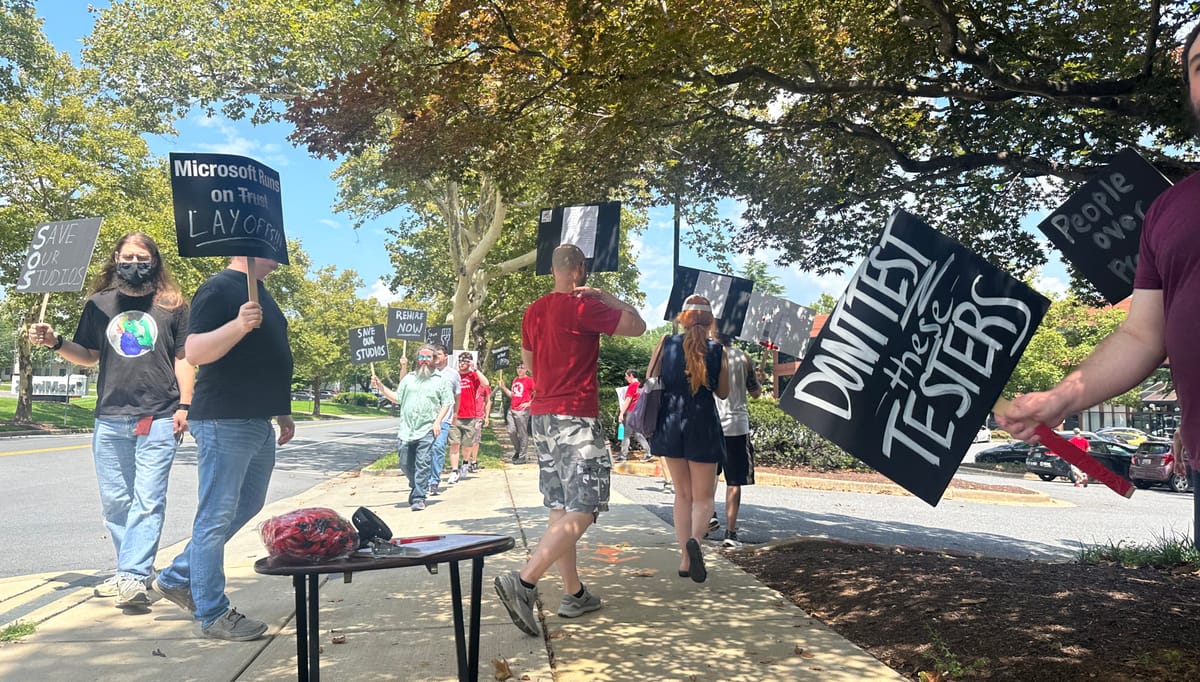
Outside the Peacock Theater in Los Angeles on Thursday, anger around the Future Class’ dissolution – as well as the callousness with which many companies handed shimmering trophies at The Game Awards continue to cast aside thousands of workers – coalesced into a protest organized by United Videogame Workers, the union anyone, even laid-off workers, can join announced by Communications Workers of America (CWA) at GDC earlier this year.
"The moment we actually tried to ask for something better – or for them to put their money where their mouth is – they just quietly killed the program.”
The theme of the protest was “The Industry Is Dead,” and many of the 50 or so developers who showed up took that to heart. A handful dressed in grim reaper outfits, while others carried signs shaped like tombstones. One read “RIP Future Class, Died Of Performative Allyship.” The UVW chair who made it, freelance writer and narrative designer Anna C Webster, was a former Future Class member.
“You’d think that we as the Future Class would at least know what the future of our program looks like,” she told Aftermath. “But they basically did not communicate that at all until we got together and said ‘Hey, what’s going on?’ To say that we’re disappointed is probably an understatement. It’s very disappointing that someone with the platform Geoff has is not using it for good. The moment we actually tried to ask for something better – or for them to put their money where their mouth is – they just quietly killed the program.”
Younès Rabii, a former Future Class member who organized an open letter urging Keighley and co to acknowledge Israel’s inhuman treatment of Palestinians, expressed a similar sentiment.
"The way that Future Class members were treated by The Game Awards, it feels like we outlived our usefulness of diverse faces smiling for the camera,” Rabii, who did not attend this year’s Game Awards, told Aftermath. “Once we tried to ask the structure to put money where its mouth was, the facade crumbled. I vividly remember that during the only meeting we had after the 2023 show, when I asked Geoff Keighley why he ignored our open letter, he angrily replied ‘This is my show, and nobody gets to tell me how I should use my platform.’ What else is there to say?"
around 40 game developers affiliated with @videogameworkers.bsky.social have gathered outside the peacock theater, where the game awards will take place in a few hours, for a “the industry is dead” demonstration
Despite the outcry that followed the initial headlines last month, Webster said that she and other Future Class members haven’t heard a peep from Keighley or program organizers since: “Nope. Nothing.”
The protest outside The Game Awards focused on far more than just the Future Class, with pro-union and anti-CEO chants filling the air. “Our industry is dead, lay off CEOs instead,” protesters shouted at various points. “No more layoffs, no more lies, no more playing with our lives.” A pamphlet handed out by UVW members summed up the grim truth of the day: “In 2025 alone, upwards of 3,500 video game workers have lost their jobs, healthcare, and security. That number skyrockets to more than 40,000 workers when you include all tech and game workers laid off in the past three years.”
Kaitlin “KB” Bonfiglio, a writer and designer who also serves as UVW's local secretary, pointed to recent reporting that suggests a Game Awards trailer spot can cost between $450,000 and over $1 million.
"There's a lot of pomp and circumstance around it," she told Aftermath, "so we wanted to make sure that we were here representing game workers – the people who make these games – raking in millions for these executives."
This was not an entirely hassle-free process. Security attempted to prevent protesters from claiming a spot outside the theater. "We had to produce our own statutes regarding this particular terrace, which is part of LA Live," said Webster. "We also have legal council, and we had them prep the information we'd need to say 'Hey, we're allowed to be here.' Eventually, they let us in, but they were trying to turn us away."
There is a history of protests outside The Game Awards, with SAG-AFTRA leading two in 2023 and 2024 as part of the since-concluded voice actor strike. Members of SAG, though not representing the guild at large, were among those who attended Thursday’s protest. Sherveen Uduwana, a freelance game developer and treasurer with UVW, said others’ past efforts served as inspiration for this year’s protest.
"This is an escalation. People have shown up in previous years to push these issues forward,” Uduwana told Aftermath. “We want to make it clear to the bosses that this is not a problem they can just wait out. We're gonna be prepared to speak to these issues: mass layoffs, taking away healthcare, generative AI. And make sure we win on those issues and workers have protections."
Midway through the protest, a procession of developers gave speeches into a megaphone.
"We are the ones who poured our blood, sweat, tears, sanity, and health into these games,” shouted one who paid tribute to a friend who’d just passed, who he said loved video games and hated corporate exploitation. “The ones who made the games are outside. [Bosses and executives] are inside patting themselves on the back. ... And what was our reward? Many of us were cast aside as soon as the products were created because we weren't needed anymore. And those who were lucky enough to stay [now] find themselves debugging ChatGPT code."
Some present had direct personal experience with the video game industry’s current layoff-centric strategy. Earlier this year, Timothy Staton-Davis, who attended the protest dressed in a grim reaper cloak and holding a plastic scythe, was part of a small round of layoffs at Brass Lion Entertainment, which is currently working on Wu-Tang: Rise Of The Deceiver.
“There were a few of us they had to let go of because of monetary issues,” Staton-Davis told Aftermath. “It’s their first game. They’re trying to pull through. They’ve been negatively affected by the current industry situation in a lot of ways because of mismanagement of money. It’s not the studio’s fault, but from our partners and all that kind of stuff.”
“My first studio gig was at Monolith,” he continued. “Now they’re gone. Unfairly so. All these studios I’ve been connected to have been negatively affected in some way, shape, or form by people not doing the right things with their money and taking advantage of folks.”
Colton "Anarche99" Childrey / UVW-CWA
Others were there to show solidarity.
“I’ve had so many friends affected [by layoffs],” said a developer doing organizing work with UVW named Audrey, who declined to provide their last name or place of employment, but who noted that they’ve yet to be laid off despite four years working in games. “I’m out here for the industry. I’m afraid that if I lost my job, I’m not gonna be able to find another one. The amount of power that gives our employers is just insane. I’ve had to work three crunches so far. The last one sent me to the hospital. I was in some of the most excruciating pain of my life. I thought my appendix had burst. Turns out, it was just stress.”
There are silver linings, though. Webster views UVW as a more authentic attempt at paving the way for a better games industry than Future Class ever was.
“We are disappointed in Geoff,” she said. “We are building the future of the games industry with or without his branding, and if he wants to join us, he can anytime.”
“UVW as an organization, a lot of the stuff that benefits Future Class members – whether it’s visibility or financial support or community – we have resources to also do all those things,” added Uduwana. “We’re looking to actually be able to make that kind of tangible change that The Game Awards and Geoff have shirked the responsibility of.”
“They decided that’s too hard,” said Webster, “so we’ve gotta do it ourselves.”
Webster and Uduwana also noted that as of now, UVW boasts 560 members.
"I’m afraid that if I lost my job, I’m not gonna be able to find another one. The amount of power that gives our employers is just insane."
"The main thing [UVW] has done for me so far is build connections – and not in a controlled forum, where we can actually be honest and have real conversations about the industry," said Aubrey. "Especially as a queer person, companies will have affinity groups and stuff like that, but HR is always there. If you say something too out there, you never know. You can't be too honest in those spaces."
Emma Kidwell, one of the Future Class members who ultimately forced an answer about the program’s fate out of The Game Awards, likes what she’s seen so far of UVW.
"I think UVW-CWA and the solidarity they've shown the [Future Class] alumni has been really great," Kidwell told Aftermath. "They're doing good, important work and using their platform to make the industry a better place."
In addition to supporting UVW, Staton-Davis is taking matters into his own hands. This year he opened a worker-owned studio called Melanated Game Kitchen.
“I’m also trying to contribute to the work of a more sustainable, equitable industry by starting a co-op studio myself,” he said. “We focus on fun gameplay, obviously, but narratives as well that tell cultural stories. It’s BIPOC-led, and we’re trying to bring that to the forefront. We don’t see enough of those stories in the industry, so we want to do more of that – and collaborate with everyone else who’s also trying to do that same thing.”
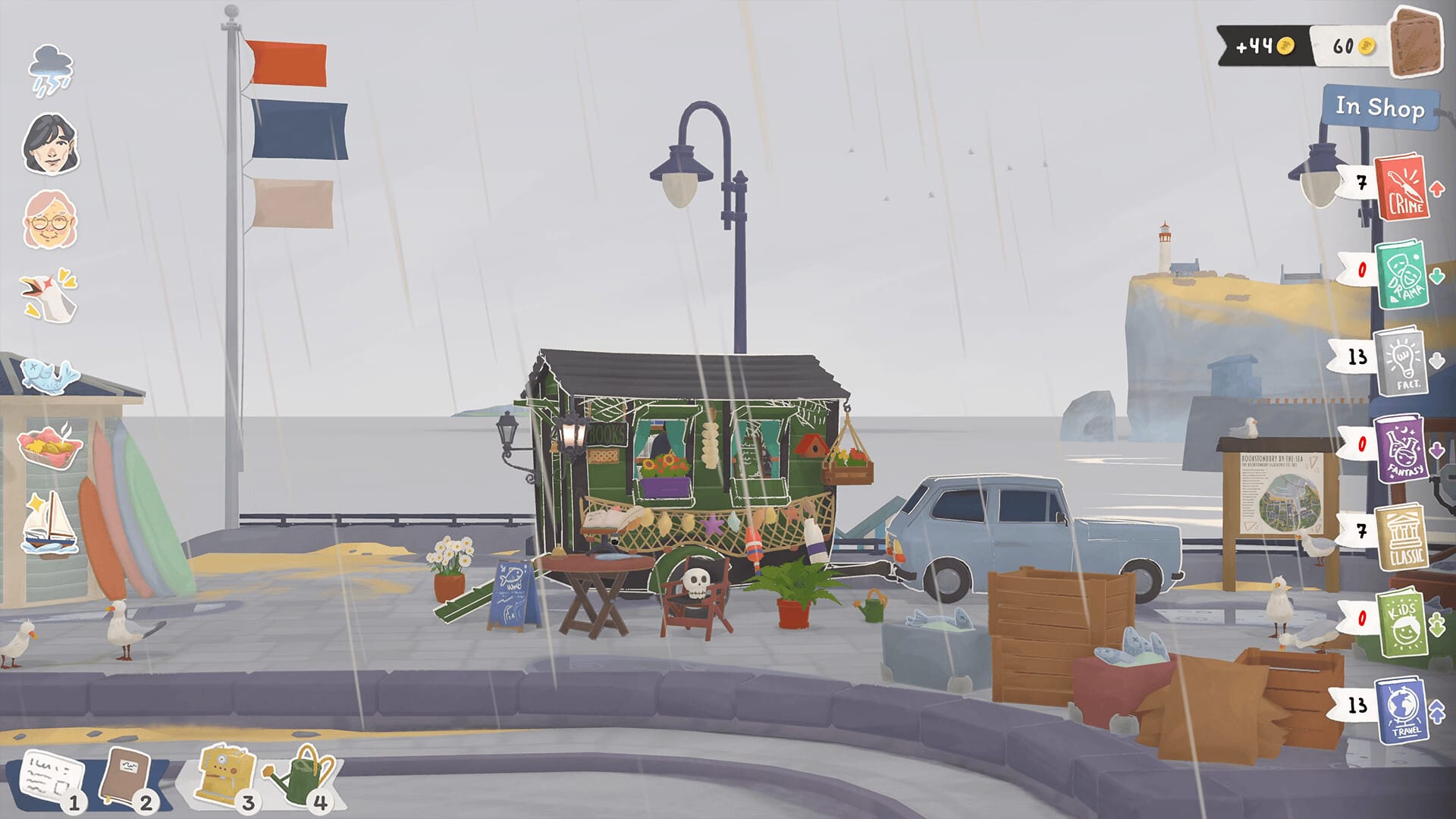
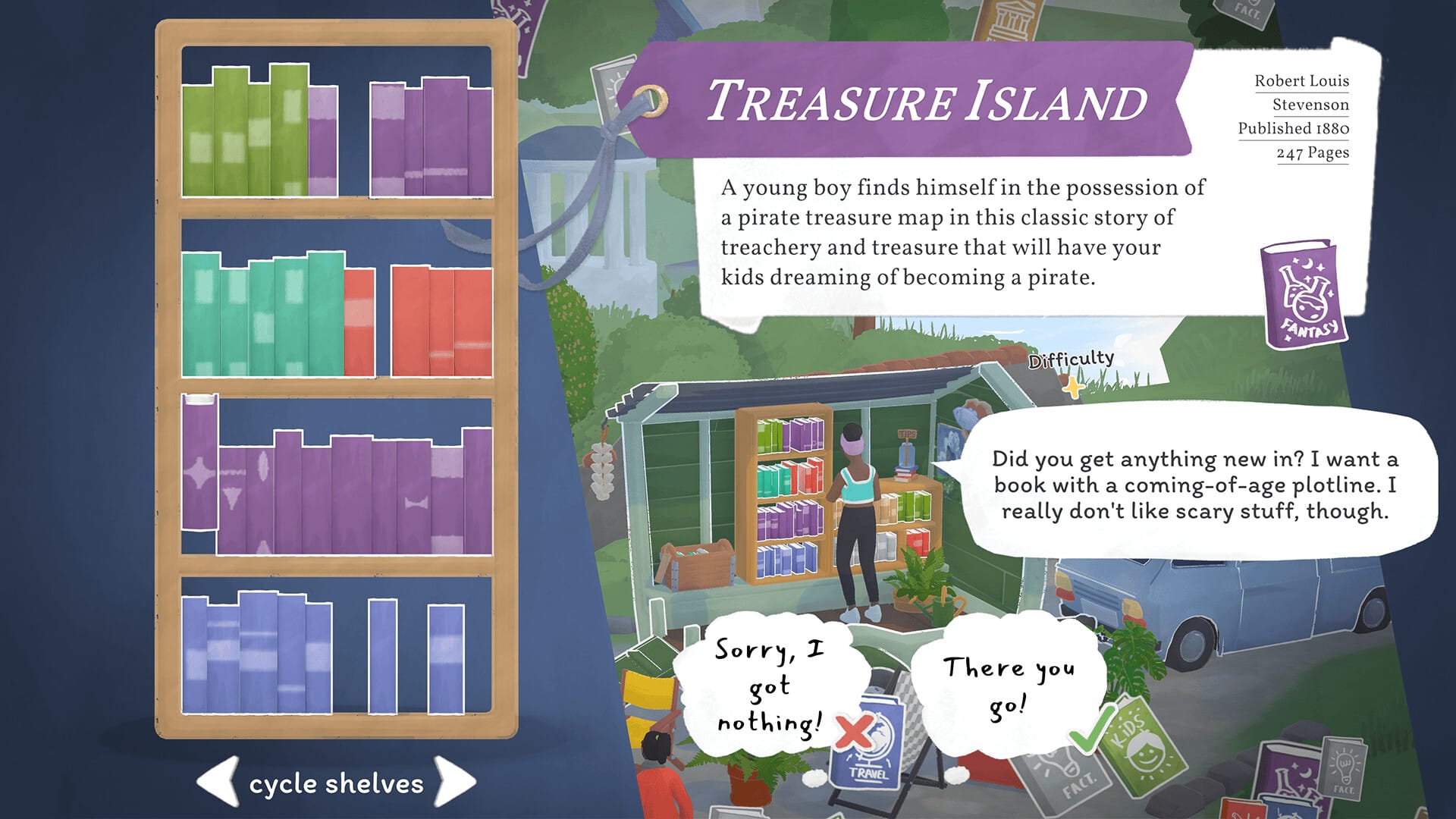
For months after Tiny Bookshop was released on Nintendo Switch in August, the indie game remained on the platform's bestseller list, hovering around the likes of Hades 2 and Hollow Knight: Silksong. But in late November, Tiny Bookshop dropped off the list—and off the Nintendo Switch eShop entirely—due to a discrepancy between its digital age and content rating and the rating tied to its upcoming physical version. Tiny Bookshop originally had an "E" rating—for everyone—but was upgraded to a "T for teens" rating.
The reason for the ratings upgrade? One word: "Arsehole," said Neoludic Games.
Tiny Bookshop remained off the Nintendo Switch store in all regions for nearly two weeks, cutting into sales on what Neoludic Games says is its most prolific platform. "The impact was immediate and severe," Neoludic co-CEO and creative director David Zapfe-Wildemann told Aftermath.
"We noticed [the game wasn’t on the store] when people started reaching out via DM asking what was going on," he said. "Because there is a small delay between the Switch backend and the public web version, we didn't understand what was happening at first."
Neoludic Games wasn't notified that Tiny Bookshop was removed from the eShop until after it was taken down. "The process was completely opaque," Skystone Games (which published Tiny Bookshop) publishing head Dmitry Muratov said.
Tiny Bookshop is a management simulator set in a mobile bookshop by a beach. Acting as the bookseller, players design the little shop and then sell books to customers; the puzzles are in finding the right real-world and fictional books to recommend. Neoludic Games describes Tiny Bookshop as "cozy," and it certainly is. The quaint bookshop is the epitome of the word, and the low-stakes gameplay makes the game very chilled out.
Muratov called the ratings process that caused the eShop removal a "black box" that the studio and publisher got caught up in. Most games have a rating, but games that are sold physically have a more "official" rating than those that are only sold digitally. The digital ratings system is handled through an automated system with the International Age Rating Coalition (IARC), which works with the different ratings agencies, like the ESRB. Developers fill out a survey through the IARC system to self-evaluate their game, which spits out an automated rating based on the answers. Developers then provide a certification of that rating to storefronts to be able to sell digitally.
Image: Neoludic Games/Skystone Games
Zapfe-Wildemann said the digital certification through the IARC required very little detail and had "a lack of clear guidelines." Other developers who spoke to Aftermath about the IARC said the system can feel subjective—something that's especially relevant following the ratings debacle regarding Santa Ragione's Horses. Horses has been in the spotlight over the past several weeks after it was removed from the Epic Games Store for its rating; using the IARC process, Santa Ragione received a Mature rating. Epic Games filed its own IARC questionnaire and found the game to be ranked as Adults Only, therefore not publishable on its storefront. (Several developers and industry experts told Aftermath that they'd never heard of a platform filing for its own IARC rating.)
The IARC rating allows for games to display, for instance, an ESRB on a digital storefront. Crucially, it's a free-to-use tool that allows developers to get their games rated without much friction—and keeps rating bodies from being overwhelmed by having to have humans go through the hundreds of games released each month. IARC spits out a rating that's adaptable for the different regions a game is released in. One video game industry expert told Aftermath that rating bodies, like ESRB and PEGI, do run checks on IARC ratings to ensure accuracy, be it popular games or ones that get complaints.
Physical editions require a more detailed rating to be sold in stores, however, which made the ESRB and other countries' ratings processes necessary for Tiny Bookshop. That process is more robust and requires developers to submit footage, builds, and marketing materials, the expert said. The result is a formal rating from a thorough assessment of a game by a human.
"We started working together with a UK-based publisher for a physical release of Tiny Bookshop," Zapfe-Wildemann said. "That process mandated getting a detailed review by each target region's rating agency. In that re-review, the ESRB flagged the word 'Arsehole' in one of the 300+ book descriptions as severe enough to warrant a 'T' rating."
Neoludic Games only learned of the upgraded rating after Nintendo delisted the game and the process was completed. "It would have been five minutes of work to replace the word had we been informed, or had we had a way to track which swear word is considered severe in the IARC system," Zapfe-Wildemann said.
"A single word in more than 100,000 words of localization was caught and scrutinized without a chance for us to fix it pre-release," Muratov said. "It’s frustrating when you see massive AAA games with much more mature themes, while a cozy bookshop game gets pulled over a single instance of text."
The upgraded T rating triggered a "mandatory update to the digital store," Zapfe-Wildemann said, which resulted in the "immediate delisting" of Tiny Bookshop. On Oct. 17, which is the last date the best-sellers page was recorded by the Wayback Machine, Tiny Bookshop was in the ninth row of the U.S. bestsellers. (In September, it was listed 12th on the page, and in August, it was the second game. In the first month alone, Neoludic Games sold more than 300,000 copies of Tiny Bookshop. By December, that number surpassed 500,000.) Being removed from the Nintendo Switch eShop dropped Tiny Bookshop from the list, Neoludic Games said. Now, after being re-added in early December, it's much further down the page in the U.S. region. Neoludic Games estimated that it lost 10,000 sales due to the removal from the eShop and its subsequent absence from the bestsellers list.
"On Switch, the bestseller list is one of the most critical discoverability tools the platform has," Zapfe-Wildemann said. "Our release momentum was still carrying us in the charts of some regions when the incident happened. It is incredibly difficult to re-enter those charts once that momentum is broken."
Muratov said that getting back into the bestsellers list is "very hard or impossible," but that the studio managed to get back into the top 30 recently. "That couldn't have happened without an amazing worldwide community rallying behind us," he said.
I’m in a fight with my landlord over getting a dog, if “fight” means I texted him about it a couple times and he never answered and now I just drive myself nuts wondering if he’s purposefully not answering so that he doesn’t have to say “no” or if he just regular isn’t answering and I should harangue him. I am a person who should have a dog, and in the absence of one, I get my fix wherever I can: friends’ dogs, convincing dogs on the street to notice me and then pretending to be surprised, and video games that have dogs in them, like Dogpile.
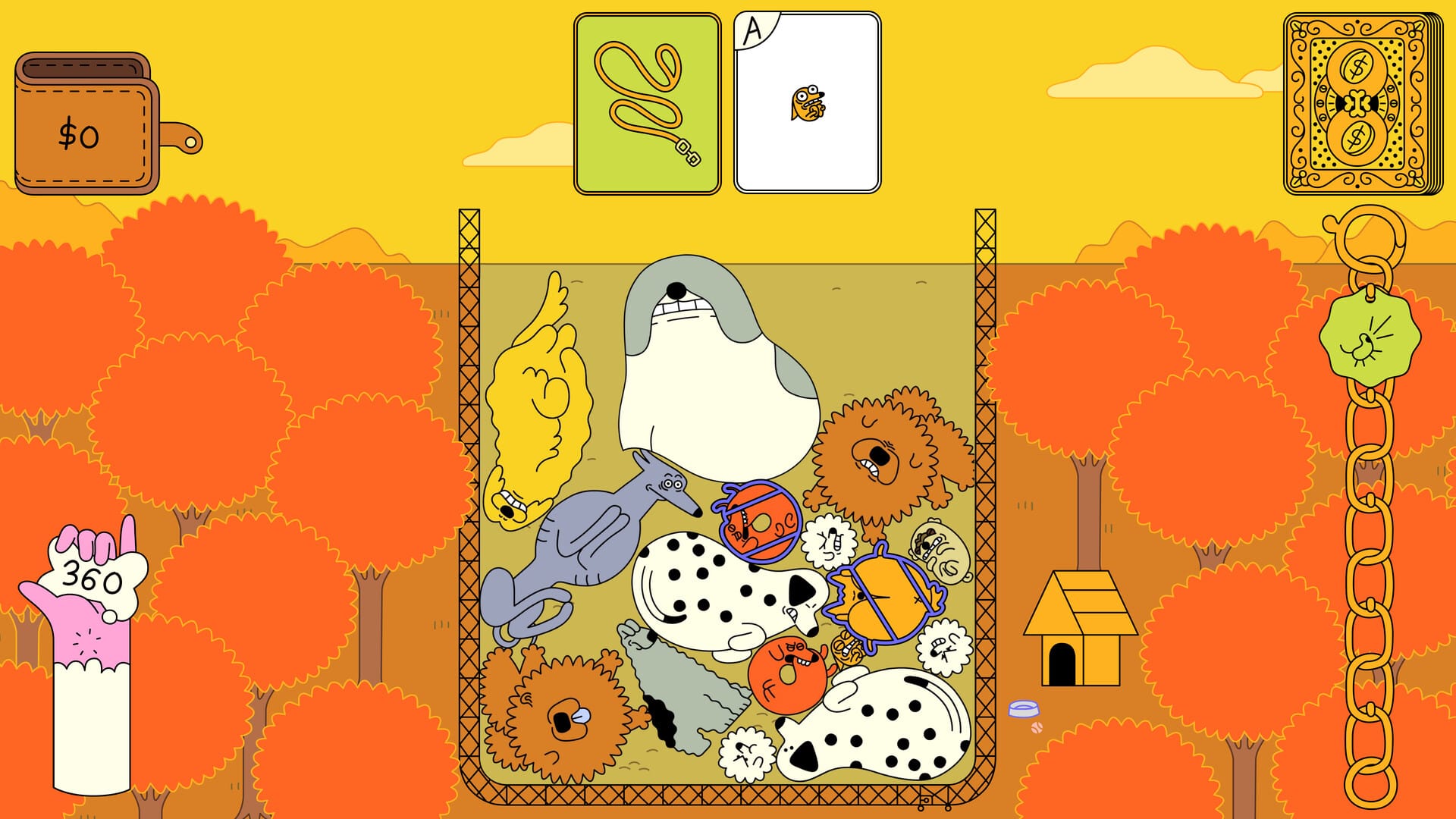
Dogpileis a collaboration between two Australian studios, Studio Folly and Toot Games. You have a deck of dog cards, which you play to drop dogs into a yard. If two dogs of the same type touch, they merge to form a bigger dog. Those bigger dogs merge to form even bigger dogs, and you keep merging dogs until you either win by getting the biggest dog, or your dogs spill out of your yard and you have to start over. There’s also the smaller goal of earning an increasing amount of “bones” in a certain number of hands, with penalties coming into play if you don’t make the requirement.
I appreciate a game that understands that the best dog is a big dog (a problem for my own desire to have a dog, since I have a very small apartment). The game’s dogs are very charming, from tiny angry chihuahuas to greyhounds that look like they’ve been up too late doomscrolling to golden retrievers that just look happy to be included.
Size isn’t the only quality of a dog you have to pay attention to. Dogs can have traits: friendly dogs will be drawn toward dogs of their type, while timid dogs will move away from other dogs. This can be really useful for space management, helping jostle dogs around to get them to touch. Some dogs can be unusually big or small, and dogs can also get fleas that make their traits not work. My least favorite trait is “crated,” which prevents a dog from merging for several turns. You can change dogs’ traits in an interface stylized like a dog wash, removing bad ones or adding good ones.
In the game’s pet shop, you can buy new dog cards or “tags” that modify your game, such as by making all the dogs super bouncy (I thought this would be great, but it backfired on me). The tags add a metagame over the whole thing that I’m sure will appeal to strategy nerds, but honestly I most like just dropping the dogs into the yard, watching them tumble and then pop into another kind of dog, and seeing all of them pile up in an awkward, jostling crush.
The whole thing is bright, cute, and chill, and it ate up most of my Friday night as I said things like “get over there, butt dog” and “aah, no more puffballs” at my computer. Dogpile is out now on Steam.
A little while back, conservatives discovered the existence of cartoons, but only their existence. What they do not know, and perhaps can’t know, is that for a brief moment cartoons got really good, and really gay, and now they are dying.
Now, I’ll be using the term ‘cartoons’ here, but when I do I’ll be referring to animated content released commercially for children and early teenagers in English-speaking countries. The term definitely excludes many things that are obviously cartoons: The Simpsons, Neon Genesis Evangelion, Arcane,Scavengers Reign, even Bluey since its core audience is too young. It’s cartoons as in ‘Saturday morning cartoon’: thirty minutes long if you count commercials, narrative-based, usually with other concerns like a toy line, with an audience who are older than toddlers but younger than teenagers.
On September 29th of 2025, the X account LibsofTikTok, run by former real estate agent Chaya Raichik, discovered the Netflix show Dead End Paranormal Park, which had been cancelled in 2023 after two seasons. In a short clip, the show’s lead character Barney talks about how working at a haunted amusement park allows him to be himself rather than just the one trans kid at his school. Having seen the show, Barney’s gender is mentioned at most a handful of times, the word ‘trans’ might only appear in the clip that Raichik excerpted.
A day later, Raichik posted a video sourced from Instagram in which a man with a British accent films his TV playing the Netflix show Jurassic Park: Camp Cretaceous, a teen-centric sidequel to the film Jurassic World in which a group of teenagers try to survive on Isla Nublar while Chris Pratt is riding motorcycles and the like. In the clip, the character Yasmina confesses that she’s fallen for the character Sammy—they are both female. The adult watching the cartoon whines ‘lord have mercy.’ The final season of this show aired in 2022.
Elon Musk encouraged his followers to ‘Cancel Netflix for the health of your kids’ shortly after Raichik shared the clips above. Culture war content isn’t exactly uncommon on Musk’s account, though it is often submerged by his genuinely side-splitting comedy and cutting-edge memes, but what are rare are references to children, childcare or fatherhood. Musk is the world’s foremost pronatalist: he believes that the world is dangerously underpopulated and that we should be ‘teach(ing) fear of childlessness’, and yet it doesn’t seem to interest him.
You already know what he is doing personally to solve this problem, but something he never does is talk about his own experiences as a father. As Joyce Carol Oates has pointed out, despite posting on average 68 times per day, he never talks about anything remotely human: ‘pride in a friend’s or relative’s accomplishment; condolences for someone who has died; pleasure in sports; acclaim for a favorite team; references to history’. More important than any of that: somebody with an estimated fourteen children never talks about them. Obviously security and privacy concerns mean that he can’t share everything, but he never posts a picture one of his children drew or a celebration of good grades.
The fact that he was surprised by the content of years-old Netflix cartoons points to something else: he doesn’t have much interest in what his own children are interested in, and it appears that few conservatives do. In this case, it means that his calls to #cancelnetflix fail to take into account the sweeping changes that have changed the cartoon industry into something unrecognisable.
Dogs in Space/Netflix
You can separate kids cartoons into rough phases. The first was the Golden Age of Saturday Morning cartoons: Transformers, G.I Joe, She-Ra and Thundercats. These were almost always tied to a toy line—they were functionally commercials, with plots dictated largely by what stock needed to be moved in a given quarter. That didn’t stop them from being incredibly popular: although viewing figures are difficult to come by because of the nature of how they were syndicated, we can see their impact through toy sales: Hasbro made $950 million from the Transformers franchise alone in the 1980s.
The second stage I don’t want to call the Silver Age, because that implies a level of value that it didn’t have. Throughout the nineties and into the early 2000s cartoons tried, mostly unsuccessfully, to replicate the success of the eighties shows. Remember Exo Force, Pirates of Dark Water, Biker Mice from Mars or SWAT Cats? With this model exhausted, new creators who wanted to make cartoons first and move product second entered the scene thanks to newly established networks like Nickelodeon and Cartoon Network, producing cult hits like Ren and Stimpy and breakout successes like Spongebob Squarepants.
Avatar: The Last Airbender was an anomaly during this time. Though it was Nickelodeon shows like Rugrats and Fairly Odd Parents, it was tonally different from almost everything else out there. You could even call it a continuation of the failed experiments of animation’s not-quite silver age: long-form stories with a large cast, a more adult approach to morality, complex worldbuilding, as well as a very clear attempt to bring anime sensibilities into western animation. It was successful, not only critically but with audiences: 5.6 million people watched its finale, it launched one bad live action adaptation, one okay live action adaptation and will soon become a trilogy when Avatar: Seven Havens debuts. It helped that Avatar’s release in 2005 came at the high point of the Young Adult fiction wave, so it didn’t seem that kids who were, say, thirteen to sixteen, had to choose between genuine children’s content and adult shows. It blazed a trail that nobody would follow for a long time—for almost a decade it remained the only show that tried to hit that sweet spot of children’s animation that teenagers and even adults could enjoy.
In a short time it became uncommon to have long-form narrative animation without at least one queer character.
If Avatar showed that kid’s shows could be blockbusters then 2006’s Adventure Time showed that they could be arthouse. Pendleton Ward’s ten minute long trips were deeply idiosyncratic, down to the strange cadence of the dialogue and the leisurely unfolding of what turned out to be one of the most complex and unique fantasy stories of the 21st century, one that is still going two decades later. I can’t say that the show has directly influenced anything else -except for Chainsaw Man- but it has instead functioned as a talent incubator for a new generation of animators (storyboard artist Rebecca Sugar created Stephen Universe, for example) and a general call to the industry to raise its game. Also, while it was not the first ever cartoon to feature a queer couple (as far as I can tell that was Hey Arnold in 1998), the centuries-long on-again-off-again thing between Princess Bubblegum and Marceline was the first involving main characters and not presented as a Very Special Episode.
In 2012, the Disney Channel released Alex Hirsch’s Gravity Falls. It’s rare that a single show can cause a paradigm shift in the industry—usually they come about from market over-saturation of the creation of new networks. Gravity Falls was different: it looked like a kids cartoon, but, speaking as an adult, it’s genuinely smart and funny. Kids could watch it, but teenagers would get it and adults would appreciate it. It wasn’t purely a cult phenomenon: the series finale, ‘Weirdmageddon’, Disney reported, was ‘a dominant #1 in its time period across all cable TV among Total Viewers, Kids 6-11, Boys 6-11 and Boys 2-11 demographics’.
While this was happening, a parallel development in young adult fiction would have ramifications for the cartoon industry: adults were starting to read books written for teenagers, which meant that books were being written for adults who wanted to read books for teenagers. The fandom for these books skewed female and queer, and the publishing industry responded by buying up books that appealed to this audience. That seems to have made solid business sense: Young Adult fiction is still on an upward trajectory, even without blockbusters like the Harry Potter franchise, thanks in part to the cross-pollination between YA and Romantasy and its promotion through BookTok.
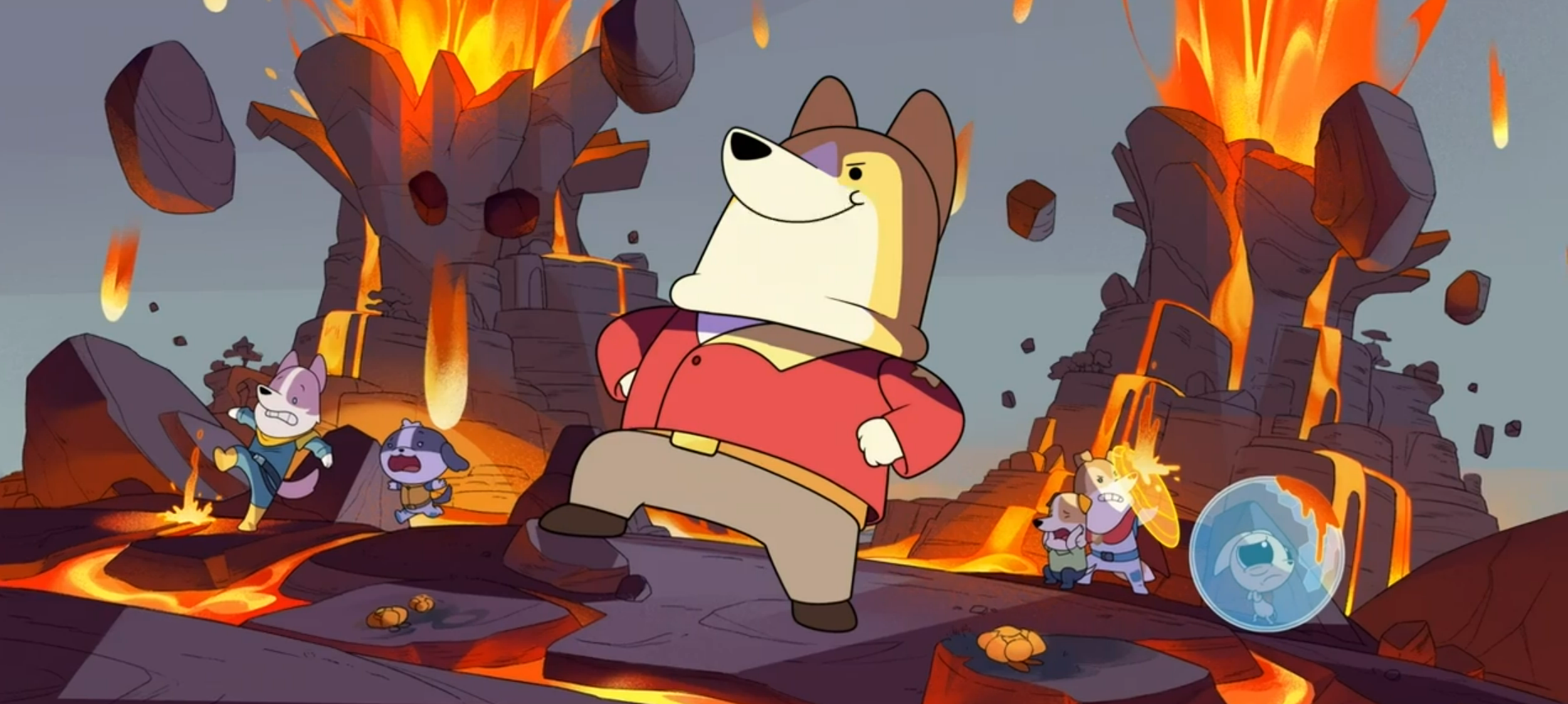
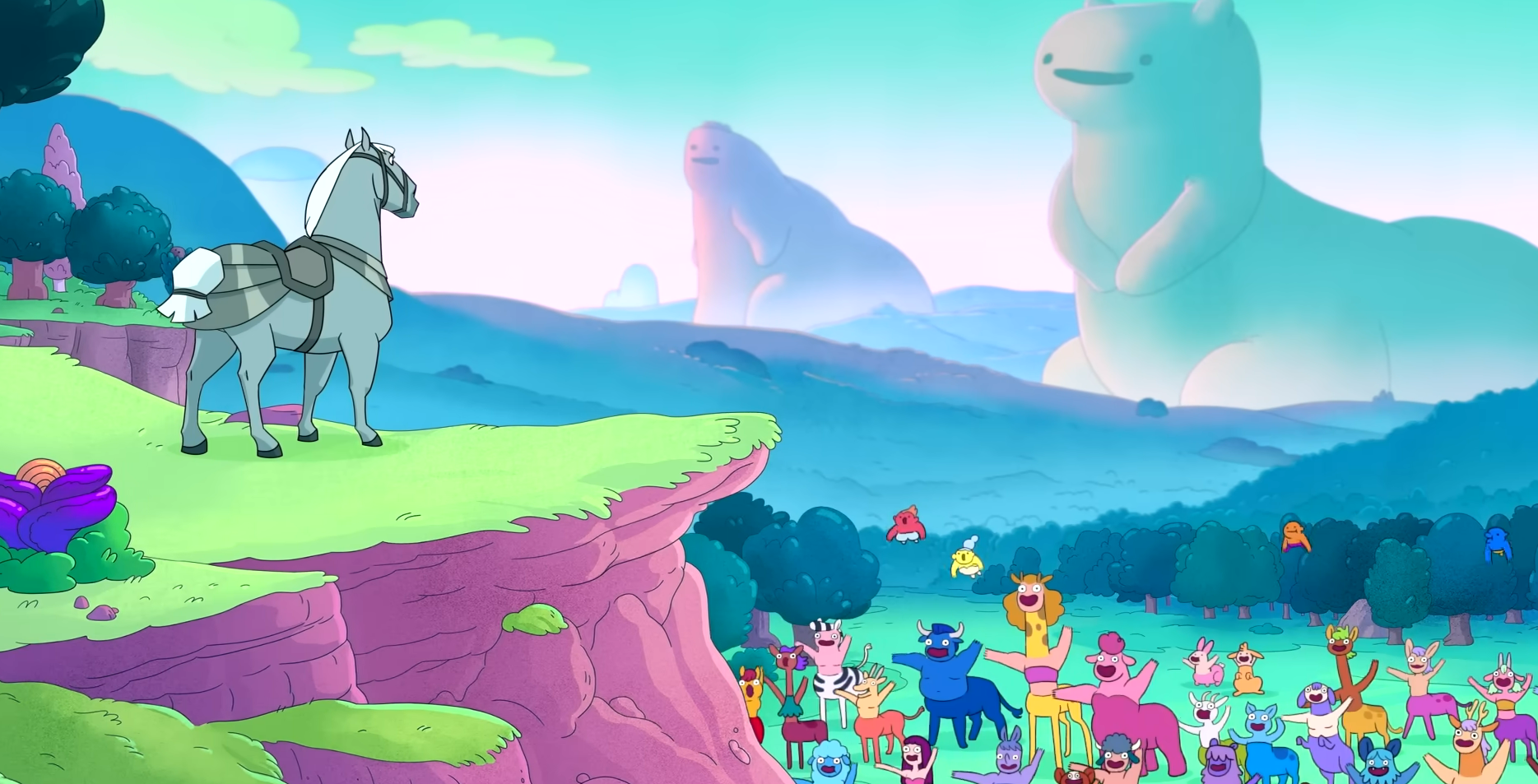
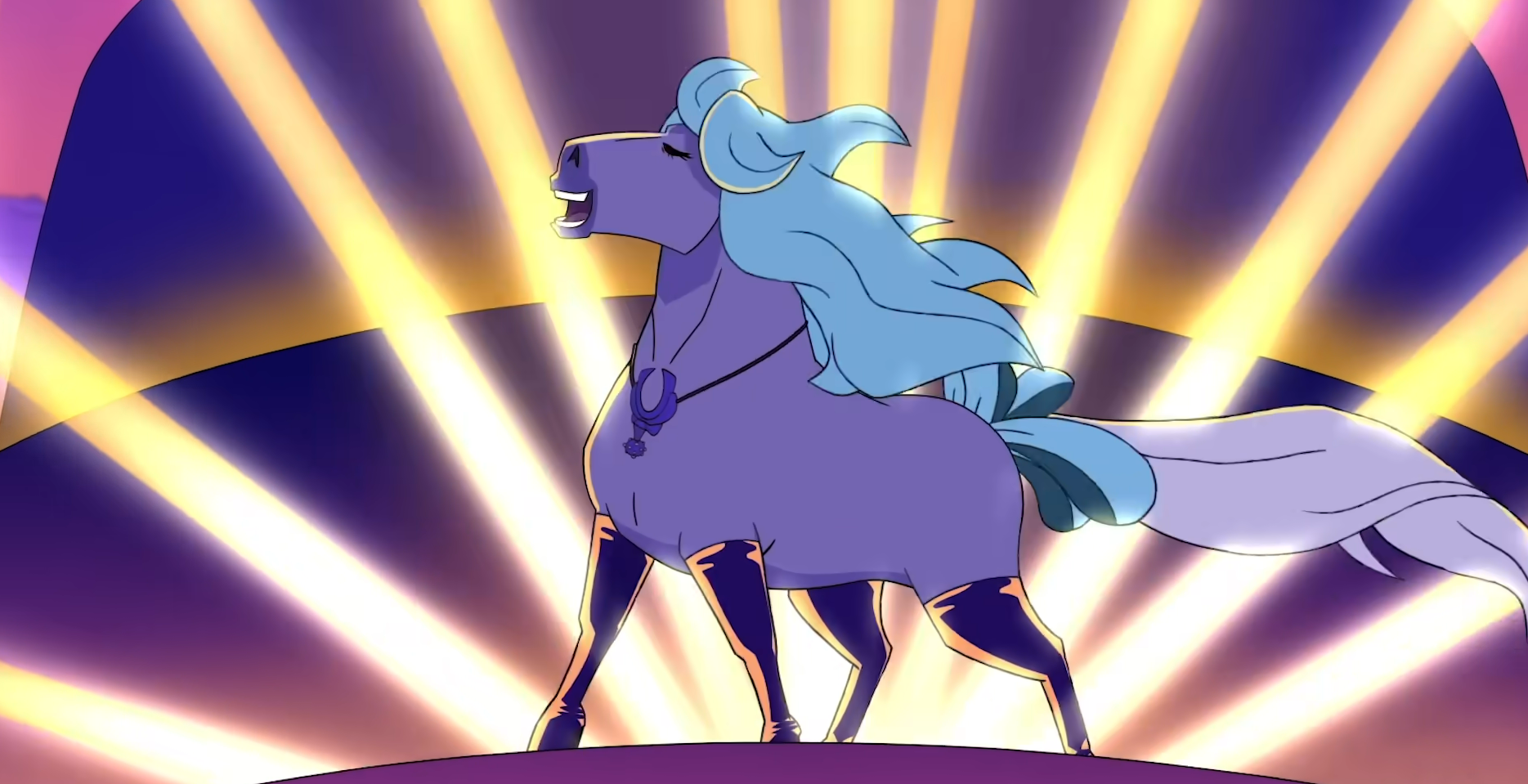
Gravity Falls and Avatar: The Last Airbender didn’t have any overt queer representation (Disney cut it out from the former and it was only present in the sequel to the latter), but their tone and style pointed the way for shows like Cartoon Network’s Steven Universe and Netflix’s She-Ra and the Princesses of Power, which caught on like wildfire in the larger ‘fandom’ community. Pretty soon most significant cartoons married the deep storytelling of Gravity Falls and Avatar: the Last Airbender with themes, such as queer representation, reflecting the adult-YA community: The Owl House, Centaurworld, Dogs in Space, Star vs. the Forces of Evil, Voltron: Legendary Defender, My Little Pony: Friendship is Magic, Amphibia, The Dragon Prince, Battle Kitty, Kipo and the Age of Wonderbeasts, Hilda, and the aforementioned Dead End Paranormal Park and Jurassic World: Camp Cretaceous. In a short time it became uncommon to have long-form narrative animation without at least one queer character. Sometimes the representation was subtle, as in Hilda where they were background characters. Several shows, like She-Ra and the Princesses of Power and The Owl House had queer main characters and their love stories were key plot points.
Jeremiah Cortez was showrunner on Netflix’s Dogs in Space during this period. He grew up loving animation, took every class he could take on it in college, and drew free-form stories about a Corgi named Garbage’s adventures in space while working at a factory job (he had no emotional connection to dogs and didn’t like sci-fi so it felt like something he could do for fun, with no emotional connection). His co-workers liked it, which led to him producing a rough short, and a chance meeting led to the opportunity to pitch Netflix.
Dogs in Space/Netflix
“So I went to Netflix,” he told me, “pitched in person, and then left, and I just thought, like, yeah, they're not interested. It was nice that I got to go to the Netflix building and see inside, but I just took it as a nice opportunity, a nice experience. And I left, went back to my job. And then, yeah, about two weeks later, they called me again and said, hey, we want to buy the show.”
There was a good vibe at Netflix at the time: “Netflix was a great studio to work with when I was there. When I got there, that was the dream studio I wanted to go with. They really believed in what they were selling—Netflix was the place where the shows that other networks wouldn’t get picked up got picked up. They were the place where all the overlooked ideas can come and be a show.”
The studio was perfectly willing to take a chance on a first-time showrunner, and were collaborators with him rather than the cliche of out-of-touch studio executives handing down notes. The only major change they pushed for was casting Haley-Joel Osmet as Captain Garbage—Jeremiah would have preferred somebody with an older-sounding voice like Will Forte. When Osmet auditioned he nailed it and Jeremiah remains extremely happy with the performance.
Cuphead and Centaurworld were both being made in the same Burbank studio, and both shared Dogs’ adults-can-enjoy-it-too vibe. As Jeremiah tells it, this came from Netflix’s genuine desire to make the best shows possible, but there’s business logic there: children are a very small and very fickle demographic, but bringing in what would be traditionally regarded as more adult elements opens animated shows up to a larger audience that includes adults. We still see this today: Hazbin Hotel and Helluva Boss, both by Vivienne ‘VivziePop’ Medrano are definitely for adults in terms of swearing and sex references, but have the vibe of children’s cartoons in a way that other adult cartoons like Scavengers Reign and King of the Hill don’t. They seem made for the generation that was just the right age when Gravity Falls, Adventure Time and Avatar: The Last Airbender were at their peak and are now in their twenties and thirties.
These shows were being made during a major shift in the way that children consumed entertainment.
The second this golden age of animation became unprofitable it stopped. You can practically pin a date down to the very week this happened: on November 15th of 2024, ten days after Donald Trump’s second election, Disney removed an episode of Moon Girl and Devil Dinosaur that dealt with trans athletes. It wasn’t the first show that a network had censored —Cartoon Network even fired somebody over the ‘Bubbleine’ romance—but this time felt different. Disney wasn’t just giving notes to writers to keep things PG, they were actively removing a show that dealt with a very specific topic that conservatives are particularly focused on. That felt like the permissive, progressive attitude that had defined the late 2010s to early 2020s was officially over.
At nearly exactly the same time, the entire age of peak animation collapsed. There were 86 new children’s animated series orders on streaming platforms in 2022 and 113 overall. In 2025, that number dropped to 24 on streaming and 35 overall. The only major new animated show for middle-childhood and teen viewers that debuted on streaming platforms in 2025 was Netflix’s The Wolf King. My own son was growing up when these shows were airing, so I watched them with him. They were all genuinely good. The second Golden Age of animation was brief, but intense—Over the Garden Wall is, in my estimation, a classic; Dogs in Space and Centaurworld needed much bigger audiences than they got.
And that was the problem. These shows were being made during a major shift in the way that children consumed entertainment. A good portion of these shows were produced by Netflix, and the world’s largest streaming media company is notoriously bad at promoting its content. Why should it bother when, being a subscription service, it doesn’t need anyone to actually watch its shows, just keep up their monthly payments?
This goes double for children’s shows: it is very difficult to actually promote children’s content. In times past you could rely on children being around on Saturday mornings and after school, watching whatever was on. Saturday morning cartoons ended on October 4th of 2014, when the CW ended Vortexx, which had been holding out long after other networks had cancelled their Saturday morning shows, due largely to FCC regulations that mandated three hours of education programming a day on broadcast TV. Later, when viewers had to actively seek out shows on Netflix, and later Disney+, these companies didn’t have a marketing strategy beyond giving them prime spots on their own platforms and uploading trailers to YouTube. There was no place where you could put an advertisement for a relatively high-budget show like Kipo and the Age of Wonderbeasts that would establish ‘this is important’.
Centaurworld/Netflix
Obviously, some children’s content does break through. K-Pop Demon Hunters is a phenomenon, but Netflix’s efforts had little to do with that—marketing analysts might say that it ‘activated fandoms at scale’, but viral clips like Jay from ENHYPHEN dancing to ‘Soda Pop’ came after the film had become successful, not before. What really happened was that enthusiasm spread virally because the film was always going to ‘activate’ the kind of people who are going to spread things virally—K-pop stans, TikTokkers, cosplayers and so on. Importantly, that level of viral success just doesn’t seem to happen for serialised shows: Netflix’s Jentry Chau vs. The Underworld, which also features K-pop and the hunting of demons, isn’t anywhere near as successful.
Jeremiah explained that “We're still in this flux. In 2024 people would say: survive ‘til ‘25, when there's going to be all these new shows getting green lit, and everyone's going to be back. We’re already at the tail end of 2025 and it's stayed pretty flat. But Netflix has K-Pop Demon Hunters, and I think this will be the catalyst for a change.”
The difficulty of (reliably) marketing to young people today has meant that an entire section of the media has functionally disappeared in a very short time. Every one of the shows above is still on their respective streaming services (save for the deeply queerBattle Kitty, which was removed when Netflix stopped supporting interactive content), but new shows simply aren’t being commissioned. Of the shows mentioned above, only Jentry Chau has any possibility of getting another season as of time of writing.
The reasons are pretty obvious: Roblox is adding millions of players each year, Fortnite is a major force in popular culture and the first generation of ‘iPad kids’ are entering their mid teens. Demon Slayer: Kimetsu no Yaiba - The Movie: Mugen Train became the highest grossing Japanese film of all time, with $512.7 million in ticket sales on a budget of $15.7 million while Wish, a film that Disney promoted as the celebration of a century of filmmaking, made $237.9 million on an estimated $200 million budget. Anime and manga are handily beating western cultural products among young people: when the French government gave children €350 each to spend on culture they didn’t spend it on Proust and Balzac, but manga, starting a ‘manga rush’. The country’s most popular animated show is a magical girl anime. Netflix, Amazon Prime and Disney+ have little reason to chase an audience that shows little interest in western animation, so they have dramatically cut their output and bought up shows like Demon Slayer and Jujutsu Kaizen to fill the gaps (though a good portion of Netflix’s anime isn’t suitable for pre-teen kids). Within three years the entire format of long-form English-language children’s animation functionally disappeared.
Now that animators can no longer rely on networks and streaming platforms for employment, many are turning to independent animation.
Or evolved. If the second Golden Age is over on streaming platforms then it continues on YouTube. Prompted by the success of ViziePop’s shows, studios like Australia’s Glitch Productions were born online and are continuing the style of peak children’s animation in shows like Murder Drones, The Amazing Digital Circus, The Gaslight Districtand Knights of Guinevere(the latter two being more adult-orientated, but still fine for older kids if you don’t mind them hearing a couple of PG-13 swears). Success is no longer getting your show picked up by one of the major streaming platforms but building an entirely digital fanbase.
Knights of Guinevere is significant because it is being helmed by Dana Terrence, the showrunner of Disney’s The Owl House, and is a very clear indictment of Disney. Terrace is an interesting figure here as the only creator who has worked across the old and new children’s media. Beginning her career as a storyboard artist on Adventure Time, she became a director on Disney’s Ducktales reboot, then got to helm her own self-created show, The Owl House. There was, it seems, a falling out between her and Disney, hence the move to Glitch.
She explains in an interview that “I was pissed off one day and this became a cathartic release… I worked with big mainstream studios for about ten years and now I don’t and I’m enjoying myself quite a lot.” The experience of working with Disney left her quite willing to burn bridges: when the company started to use generative AI in their shows, she tweeted ‘Unsubscribe from Disney+. Pirate Owl House. I don’t care. Fuck gen AI.’
Collectively, these shows are chalking up hundreds of millions of views—The Amazing Digital Circus’s pilot has 398 million views as of time of writing, and though some will be repeats (about eight are mine) that’s an incredible viewership for a show with zero marketing budget beyond the Glitch brand name. These shows are also interesting for their business model. YouTube alone wouldn’t fund the large, professional operation that is currently producing three high-quality shows, so they supplement their funds with merchandising.
Glitch Productions’s output and other web series like Lackadaisy are syntheses of the two golden ages of animation: relatively sophisticated Young-Adult orientated stories supported by business models heavily reliant on merchandising (though unlike eighties Saturday morning cartoons, the stories far and away come first). Despite their success, they are a niche within the larger online world and, although some are now available on streaming services, are hamstrung by releasing episodes every few months and the fickle nature of virality. Now that animators can no longer rely on networks and streaming platforms for employment, many are turning to independent animation, and unfortunately few are breaking a million views.
Centaurworld/Netflix
The Amazing Digital Circus racks up hundreds of millions of views per episode, while The Gaslight District’s pilot has just broken twenty million views after six months. Non-Glitch indie animations exist, but none have broken through like Digital Circus, which has been snapped up by Netflix.) Independent animation can be successful on its own terms, but there are no points for indie cred in children’s animation, especially when you have something to say. This isn’t like the indie music boom of the 1980s, where the This Band Could Be Your Life generation were creating sounds that nobody could hear on commercial radio and MTV. Music would still exist if Steve Albini never sat behind a mixing deck–if these shows don’t fill the void left by major studios, then there will be no animated narrative fiction for children.
That matters. I can see what these shows meant for my son and how they benefited him. He is more emotionally intelligent than I was at his age and better able to understand complex narratives, and that isn’t just going to make him better at understanding fiction, but better at understanding people. Part of that is not having parents who were lead-poisoned in a decaying mining village then hammered into the rough shape of adults by the military like I did, but part of that is that he grew up watching stories about people with feelings instead of extended toy adverts. Kids younger than him are going to grow up watching other kids play videogames or whoever replaces Mr. Beast after his inevitable cancellation and/or arrest. That type of ‘content’ (because it is content, not art) is fine in moderation, but people need stories.
More than that, while children’s cartoons can’t undo centuries of systemic racism and sexism, representation does still matter. Fiction is inherently destabilising because it cannot help but force viewers to see things outside of their perspective. If a creator feels that a character should be black or queer, or if an artist draws a character wearing a hijab because that’s where their inspiration takes them, then that’s what viewers get. Because long-form narratives can put in the work to develop diverse characters,viewers can learn the most important lesson that stories can teach us: we are somehow both radically similar to and radically different from each other. There needs to be more than one production company making these shows or a whole way to communicate to kids is going to disappear.
It turned out that capitalism won the battle before reactionaries even knew that they were fighting.
Which brings us back to LibsofTikTok. Because of the way that conservative parents relate, or rather don’t relate to their children they will have little interest in what they are consuming. The number of conservative families who will genuinely raise their children fully outside of the mainstream is going to be very small. Living a trad lifestyle takes money that only a tiny percentage of people will have. Most conservative households are going to parent for the most part like more liberal households, by doing the best they can with limited resources, and part of that is allowing kids to have time in front of a TV or iPad.
The difference will be emotional coldness, indifference to suffering and a greater incidence of abuse. Starting after Brown vs. Board of Education, the Christian far-right in particular has developed a parallel theory of child-rearing as disciplines like attachment theory and critical pedagogy made most childhoods kinder and freer (with support from shows like Sesame Street and Mr. Rogers Neighborhood). Talia Lavin’s book Wild Faithdetails how this mirror-world came into being: home-schooling, religious schools and camps, and parenting manuals like James Dobson’s 1970 book Dare to Discipline. This instructed parents to ‘bring some pain to the child when it is necessary for his eventual good.’ One person who grew up in a conservative Christian household told Lavin that “almost every spanking I’ve ever received was a result of asking ‘why?’”. This is not a lesson that is compatible with the worldviews of the kind of people who want to make children happy by making fun shows for them. The long-term effects of this type of parenting are very well documented.
Not every conservative is Christian (Raichik is Jewish, Musk atheist), but every part of the authoritarian ecosystem puts their own spin on these ideas. For most it’s nothing as systematic as the dictates of a parenting manual—more likely its arbitrary punishment, inconsistent discipline and general disinterest in the emotional life of children. Plenty more are more like Finn from Adventure Time’s parents: kind of, sort of okay people, but so wrapped up in their own problems and so laden with their own baggage that they can’t really ‘parent’ as such. Nowhere in authoritarian (or simply shitty) parenting is there space to sit down with your kid and watch shows together.
We can see that in one of the largest and most successful authoritarian parents’ campaigns in recent years, Moms for Liberty: their target was books. Only one in three children enjoys reading and one in five actually reads every day, while they spend seven and a half hours each day in front of screens. However, parents can pick up books, flick through them and see horrors like the mouse penis in Maus, while they have to actually sit down and concentrate to find out that the protagonist of Dead End Paranormal Park isn’t just trans, they’re trying to save demons from an angel. Their lack of concern for their children as human beings meant that they never noticed the second golden age of cartoons, which let dozens of shows grow and a generation of artisans hone their craft.
So it turned out that capitalism won the battle before reactionaries even knew that they were fighting. If they were more invested in the lives of their children as children then they would have seen that animation has so fundamentally changed in the past two years that there is no need to #cancelnetflix. Netflix cancelled itself, or its animation arm at least, and with it an entire medium for communicating with children, one that I believe they benefitted from. Perhaps in 2028 LibsofTikTok will notice that Zooble from The Amazing Digital Circus is an allegory for trans experience and get all worked up about that, but until then the rest of us, and our children, are going to have to live in a media environment that is increasingly less human.
When Verizon refused to unlock an iPhone purchased by Kansas resident Patrick Roach, he had no intention of giving up without a fight. Roach sued the wireless carrier in small claims court and won.
Roach bought a discounted iPhone 16e from Verizon’s Straight Talk brand on February 28, 2025, as a gift for his wife’s birthday. He intended to pay for one month of service, cancel, and then switch the phone to the US Mobile service plan that the couple uses. Under federal rules that apply to Verizon and a Verizon unlocking policy that was in place when Roach bought the phone, this strategy should have worked.
“The best deals tend to be buying it from one of these MVNOs [Mobile Virtual Network Operators] and then activating it until it unlocks and then switching it to whatever you are planning to use it with. It usually saves you about half the value of the phone,” Roach said in a phone interview.
Fannish communities feel a sense of ownership over their media, but this feeling does not make them powerful in a sense.
Like the poachers of old, fans operate from a position of cultural marginality and social weakness. Like other popular readers, fans lack direct access to the means of commercial cultural production and have only the most limited resources with which to influence entertainment industry’s decisions. (…) Within the cultural economy, fans are peasants, not propreitors, a recognition which must contextualize our celebration of strategies of popular resistance.
Jenkins, Henry. 1992. Textual Poachers: Television Fans and Participatory Culture. New York: Routledge. This cultural marginality appears in the definition of fandoms and in the past few posts, I was looking at fandoms through the lens of ‘save our show’ campaigns with Savage (2014).
First, we discussed how viewing communities and a sense of ownership develops which enables these campaigns. This affection also appeared in what viewers wrote in their letter campaigns but was far from the only or even most effective tool they used. Savage (2014) describe a variety methods. One way was to prove to be valuable as an auidance despite the Nielsen ratings which is possible through highlighting certain characteristics of the community: their demographic attributes or their loyalty.
Niche marketing (for example, gay programming) or strategic diversity values demographic attributes, particularly attributes that – in advertisers’ eyes – are connected to purchasing power or potential interest in certain particular products. Sender, Katherine. 2007. “Dualcasting: Bravo’s Gay Programming and the Quest for Women Audiences.” In Cable Visions: Television beyond Broadcasting, edited by Sarah Banet-Weiser, Cynthia Chris, and Anthony Freitas, 302–18. New York: New York University Press. Patterson, Eleanor. 2018. “ABC’s #TGIT and the Cultural Work of Programming Social Television.” In “Social TV Fandom and the Media Industries,” edited by Myles McNutt, special issue, Transformative Works and Cultures, no. 26. http://dx.doi.org/10.3983/twc.2018.1147.
Audience loyalty is an emotional investment that can translate to longterm planning and, also, purchasing power. Abbott, S. 2010. The Cult TV book: From Star Trek to Dexter, New Approaches to TV Outside the Box. Soft Skull Press. In other cases, audiences looked for sponsors and advertisers themselves or the already existing viewing community advertised the show to potential new viewers or educated each other in how to watch the show the right way (through broadcast, cable, streaming etc.), the right way here being the ones that generates the best data. Data fandom is something we have discussed before in this post. Just like then, no matter if we see these cases as the producers guiding the behaviour of fandom or fandom behaving in a way that makes it so that the producers will find beneficial to make certain decisions, at the end of the day, it is the logic of the market that is behind these behaviours. We would have to say: everything is for sale, including… Savage, Christina. 2014 “Chuck versus the Ratings: Savvy Fans and ‘Save Our Show’ Campaigns.” In “Fandom and/as Labor,” edited by Mel Stanfill and Megand Condis, special issue, Transformative Works and Cultures, no. 15. https://doi.org/10.3983/twc.2014.0497
This week, Gita, Riley, and Chris talk about many games that came out recently that will never win a Game Award, and what our attitudes about the event are. First, the enigmatic Ys-alike Angeline Era, a beautiful game with thoughtfuldesign. Second, the toe tapping Rhythm Doctor which feels like it takes cues from Rhythm Tengoku and iNIS games like Ouendan.
Then we discuss Skate Story, Faustian Tony Hawk with an incredible soundtrack that reminds us of Arctic Eggs. We give a shoutout to Demonschool, which has surprisingly good combat. Finally we discuss Shadow Labyrinth, the Dark Pac-Man game (announced at The Game Awards) that came out over the summer and has shockingly deep roots in UGSF lore.
Lastly, we shout out Nightreign as one of our favorite games of the year and talk about its freaky new characters. We also answer your questions about peppermint treats, the NY game dev scene, AI and more!
Today the overwhelming majority of workers at Doom studio id Software – 165 of around 185 total employees – announced that they’re forming a wall-to-wall union in conjunction with Communications Workers of America (CWA), the union that’s aided thousands of game workers across Microsoft in organizing.
"id Software is historically important – one of the more famous American studios that survived a length of time that few others have,” id Software producer Andrew Willis, who was part of the organizing effort from the jump and filed the initial paperwork to CWA, told Aftermath. “So it feels really awesome to get this done for something with such historical and cultural importance."
"With Bethesda unionizing, it was a push for people [at id] to start talking, and that's when it started,” id Software lead services programmer Chris Hays told Aftermath. “But then the big push that got it rolling was the closure of Tango [Gameworks] and layoffs within Microsoft at Arkane Austin. It was a wakeup call for a lot of people. People decided that it was time that we took our future into our own hands."
"The big push that got it rolling was the closure of Tango [Gameworks] and layoffs within Microsoft at Arkane Austin. It was a wakeup call for a lot of people."
id itself, Hays said, has suffered “a few” layoffs “here and there” in recent years, but nothing comparable to the scale of Zenimax Online Studios, which lost hundreds of employees earlier this year amid Microsoft’s latest round of mass layoffs and project cancellations. Now, he believes, is the time to secure workers’ rights – before the scythe swings, as opposed to after.
"Not that we're not scared that [layoffs] will one day come," said Hays. "In fact, avoiding each of the previous rounds has made us more anxious about if the next round will be us. And the most recent round of layoffs happened after several [studios] had already organized. People [at id] can see what it was that they got. We got to see them negotiating where they didn't actually lose their jobs [for a couple months]. They were still on payroll. They still had their health insurance. ... They had the extra time to make sure they could get their lives [in order], and many have actually gotten their jobs back through negotiations on where they could place people in the company."
CWA has been able to successfully unionize so many studios within Microsoft and Activision Blizzard in large part due to a legally binding neutrality agreement it struck with the company in 2022 when it was facing regulatory scrutiny over its $68.7 billion purchase of Activision Blizzard. That deal lapsed earlier this year, but according to Hays, only on the Activision Blizzard side of things.
"For us under Zenimax, there's actually a separate neutrality agreement, and that one is still valid until May [2026]," said Hays. "But that was definitely on our minds when we were looking at when we wanted to think that we had enough support [to unionize]. … We knew that it was really special for us to have the neutrality agreement, to have the freedom to be able to talk to each other more openly and not face the kind of pushback you would have in other unionization campaigns. We wanted to make sure that we took advantage of the benefit while we had it."
While the union plans to conduct a bargaining survey before members go to the table with Microsoft to hammer out a contract, preliminary discussions have focused on a few pillars: benefits, remote work, and AI.
"There's a lot of blind spots in our benefits, and a lot of us don't know what we have and what we don't and where things are lacking,” said Hays. “When talking with a lot of people, some would say 'Oh, I think we're lacking this particular kind of benefit, or something around child care.' Personally, I'm really motivated to get protections around remote work and responsible use of AI."
"There's definitely a directive from Microsoft to use [AI] more.”
Remote work has been a sticking pointat multiple Microsoft studios, with many issuing return-to-office mandates despite teams’ demonstrable success collaborating from across the country – and even the globe – in 2020 and 2021.
"We actually launched Doom Eternal during covid,” said Hays. “The month of [the launch], we started our work from home. ... We did a launch event, the whole internet fell apart, and we had to learn how to do all of that remote. And then starting a project [Doom: The Dark Ages] from the beginning, all remote, we learned a lot of lessons. On my team, we learned to change how we work, to be more remote friendly. We ended up becoming more productive as a result. So we've done this before. We've learned lessons, and I think we can continue to use that. We shouldn't just throw away all the great wins we got with remote work."
As for AI, Willis was cagey about precisely how it’s being used within id, noting that going into specifics would involve divulging secrets about proprietary tech. But he said that in his view, some of the current applications are “good,” while others are… less so.
"There's definitely a directive from Microsoft to use [AI] more,” Willis said. “In what ways and how careful they're being about implementing it within the studio to actually benefit the creation of a better game or a more efficient process, I personally don't think that's being done in a careful enough way to have it be beneficial.”
Last year, the Zenimax QA union secured AI protections that commit the company to uses of AI that "augment human ingenuity and capacities ... without causing workers harm" and require that Zenimax provides notice to the union in cases where "AI implementation may impact the work of union members and to bargain those impacts upon request." Willis and Hays hope the new union can make something similar happen under id’s roof.
"We are going to be in a fortunate position in that we have a lot of other people who've gone through this,” said Hays, “so we can look at what they have bargained for, especially around AI, and take that as a starting place, which hopefully means that it's going to be easier for us than anyone before."
"It would be difficult to say [if we’ll make Israel a core bargaining issue] without seeing what the bargaining surveys comment on, but I can say for myself personally that, yeah, I want no part in [Israel's] usage of Microsoft tools and the deals between Israel and Microsoft," said Willis.
"The folks that are in charge of a lot of these decision-making processes, it's a lot of Ivy League MBAs, a lot of folks with zero game experience."
More broadly, Willis believes the union will allow for more input from developers, as opposed to execs who have never shipped a game and, indeed, might not play them at all.
"We see the direction the industry is headed,” said Willis. “The folks that are in charge of a lot of these decision-making processes, it's a lot of Ivy League MBAs, a lot of folks with zero game experience – not just from the management standpoint, but zero experience in actually making games. ... I find little evidence of them really enjoying games or playing games personally."
“I think the more video game studios that unionize, and the greater percentage of video game employees that are in a union, it's not just better for them as individuals or folks that are raising families or have mortgages; it keeps talent from shedding,” he added. “You get to keep people in the industry who have experience and the amount of game credits that allow them to do things and create games that a contract-only or much more volatile workforce simply couldn't.”
In response, we created this non-smart TV guide that includes much more than dumb TVs. Since non-smart TVs are so rare, this guide also breaks down additional ways to watch TV and movies online and locally without dealing with smart TVs’ evolution toward software-centric features and snooping. We’ll discuss a range of options suitable for various budgets, different experience levels, and different rooms in your home.
If you’re prone to scrolling for a frankly unhealthy number of hours per day, you might have recently seen a couple names pop up with borderline-bizarre frequency: Polymarket and Kalshi. These sites bill themselves as “prediction markets,” but the activity they center around is, on no uncertain terms, gambling. Polymarket and Kalshi shroud this in marketspeak, allowing people to buy up yes/no “contracts” on real-world events and adopting a peer-to-peer approach instead of heralding down edicts about house odds, with prices instead set by trades a la financial markets. But the sites still take a cut of transactions, and people are still, in aggregate, betting millions.
Polymarket and Kalshi let users place cash or crypto wagers on just about anything. For example, as of this writing, Polymarket’s trending tab included Time’s 2025 person of the year, a bunch of different sports matches, Netflix’s proposed acquisition of WB, Elon Musk’s tweets, Trump’s release of the Epstein files, and most grimly of all, whether or not the US will sink another oil ship associated with Venezuela.
Polymarket – which was banned in the US back in 2022 after the Commodity Futures Trading Commission found it was offering betting contracts without the agency’s approval, only for the agency to drop its investigation this year and give the site a regulatory thumbs up – even allowed users to bet on whether it would go live in the US this year. Odds prior to its rollout this month were at 99 percent, according to Fortune. Kalshi, meanwhile, has managed to circumvent states’ laws against sports betting due to its financial market status, though Nevada recently closed that loophole, and Massachusetts may soon follow suit.
While obvious offshoots of the sports gambling craze that has swept the nation in recent years – promising impoverished citizens a last-ditch means of getting out of debt while actually just miring them in more – Polymarket and Kalshi have recognized that their fortunes are tied to news. The two have approached this in different ways. Kalshi recently struck deals with both CNN and CNBC to integrate its prediction data across the networks’ programming. In a press release, Kalshi cited the fact that it "recently called the NYC Mayoral election eight minutes after polls closed, hours before the media" as evidence that this is good for news and society, actually, and not yet another rotten seed that will eventually sprout an ill-gotten money tree. Also, the system is easily gamed, as Slate recently pointed out:
If a Republican political firm wanted to buy $50,000 in contracts on the GOP to win the House, that purchase alone could move the price — and thus the implied odds — significantly. If a Republican political consultant wanted to buy $100,000 worth of contracts on the GOP to hold the House, they could materially move the price and thus the implied odds. With CNN providing free media coverage of the party’s improving chances, wouldn’t that be a compelling alternative to simply buying some commercial time? Are you starting to see the problem with a major news channel using an opaque tool of financial speculation to sum up conventional wisdom about an election?
Polymarket, on the other hand, has favored a more digital-first approach, striking a deal with Twitter to become the platform’s official prediction partner and going all-in on news aggregation with both its official account (which has over 800,000 followers) and offshoots, including NewsWire US, a separate aggregator it recently purchased. Both Polymarket and Kalshi have also partnered with various influencers, some laughably disreputable.
All this in mind, you will not be surprised to learn that Polymarket and Kalshi both have pages for multiple video game award shows, most prominent among them last weekend’s Streamer Awards and today’s Game Awards. Gamers represent an especially tantalizing prospect for gambling companies, with gacha mechanics and casino-funded streamers getting them started early so they can eventually graduate into full-blown betting.
Polymarket’s Streamer Awards streamer of the year category commanded a total trading volume of $24,169 – an impressive sum until you consider The Game Awards’ game of the year category, on which users have wagered nearly $40 million. Kalshi users, meanwhile, have wagered $218,771 and $3 million, respectively, on the same award categories. Both sites feature additional pages for other award categories, as well as things hosts might say.
When The Streamer Awards’ host, popular Twitch streamer QTCinderella, caught wind of her event’s Polymarket pages, she was furious.
“I would like to make this very clear: I am in no way associated with that website, and I am in no way condoning that website,” she said during a stream earlier this month in response to a viewer who accused her of supposed “insider trading.” “I have no association with them. I do not. In fact, my lawyers are talking to their lawyers because I am not happy about that.”
She added that her IP was being used without her consent and that her lawyers sent the site a cease and desist letter. As of this writing, however, Polymarket’s Streamer Awards pages remain accessible – as do Kalshi’s – even though the event has since concluded.
Aftermath reached out to QTCinderella and Polymarket for more information but did not receive a reply.
The Game Awards’ stance on prediction markets is unclear. Aftermath reached out to the organization to ask if Polymarket and/or Kalshi have received Geoff Keighley’s world exclusive seal of approval, but did not receive a reply.
Kalshi does not even consider The Game Awards to be that big of a deal, in the grand scheme of things.
“That is a… decent number,” Kalshi rep Jack Such told Polygon about The Game Awards’ market. “It’s OK. But some markets have hundreds of millions.”
While Such claimed that individual pages are tended to by a dedicated market team because “every market you see on Kalshi requires a pretty extensive legal contract,” it’s hard to imagine that any specific page registers as more than a temporary blip on Kalshi or Polymarket’s radar. After all, they make their money in aggregate. That’s why it behooves both companies to, as Kalshi CEO Tarek Mansour recently said, “financialize everything and create a tradable asset out of any difference in opinion.”
Somehow, what that actually entails is even more sinister than it sounds.
"It's part of a larger trend in Silicon Valley to insert themselves into the cracks of modern society,” Ryan Broderick of Garbage Day said in a recent video. “Everything that's bad about the world, they don't want to fix it. What they want to do is figure out a way to become a middle man in that system to offer a crappier version of what we already used to do."
![[syndicated profile]](https://www.dreamwidth.org/img/silk/identity/feed.png) aftermath_feed) wrote2025-12-18 02:09 am
aftermath_feed) wrote2025-12-18 02:09 am